Robotics and Control Laboratory

This facility allows you to design, programme and build autonomous robotic devices

Robotics & Control Lab

F25/26

Fulton Building

DD1 4HR

.
.
School of Science and Engineering Mechanical and Industrial Engineering Facility Research facility

About

You will have access to a range of robotic development kits, including large industrial robotic arms to autonomous vehicles constructed and controlled using Lego Mindstorm. You can use various interfaces to programme and test functional systems and you can embed sensors and actuators to control robotic devices.

Software such as Labview and C programming allows students to compile instructions to control the sensors and actuators via microcontroller boards allowing devices to be programmed to undertake a range of tasks. 

Equipment and facilities

  • Industrial robot
  • Robotic development arms
  • mBed microcontroller development boards
  • NI Elvis boards with Quansar developer boards
  • Lego Mindstorm kits

Engineering Materials Testing Laboratory

This laboratory is used for the preparation and examination of engineering materials

Fulton Building

DD1 4HR

School of Science and Engineering Mechanical and Industrial Engineering Facility Research facility

About

The material laboratory is also used in conjunction with a laboratory based in the Physics Department (Harris Building) which has Scanning Electron Microscopy (SEM) for analysis of engineering material samples. This has both imaging and chemical (EDX) functions providing advanced material characterisation techniques.

We have facilities to carry out practical experiments which complement the teaching during lectures. It can be used during your final year honours project, where you receive training and can then use it independently.

Research students use the laboratory to carry out testing and analysis as part of their research.

The facility offers a range of testing and analysis techniques that many businesses may not possess. It could prove useful to any business who requires sample characterisation, mechanical testing or material development.

Equipment and facilities

All of our equipment is maintained by experienced technicians and operated by knowledgeable researchers

  • facilities to prepare metallographic samples
  • viewing and imaging of metallographic samples
  • heat treatment furnaces
  • welding services
  • impact testing equipment
  • tensile testing equipment
Geolocation
56.457845818265, -2.9808242418483

Applied Laser Technology Laboratory

Provides hands-on and basic knowledge of laser systems used in manufacturing
two men using the Applied Laser Technology Laboratory

MG. 9E

Harris Building

DD1 4HR

.
.
Professor Amin Abdolvand
+44 (0)1382 384694
School of Science and Engineering Mechanical and Industrial Engineering Facility Research facility

About

Fully enclosed high-power pulsed laser systems for materials surface processing and engineering in the Materials & Photonic Systems (MAPS) Group laboratories at the Engineering & Applied Sciences Discipline.

The facility comprises 3 high-power pulsed laser systems operating at different wavelengths for metal, glass and polymer surface processing and engineering. 

Equipment and facilities

Fully equipped UV laser system

  • Nominal Average Power 3 W ±5 %
  • Peak Power 30 kW max.
  • Pulse Width 6 ns (@ 20kHz)
  • Wavelength 355 nm
  • Modulation 20kHz to 100kHz
  • Applications: Micro/nano materials processing /structuring/ablation

Fully equipped Green laser system

  • Nominal Average Power 10 W ±5 %
  • Peak Power 33 kW max.
  • Pulse Width 12 ns (@ 20kHz)
  • Wavelength 532 nm
  • Modulation 20kHz to 100kHz
  • Applications: Micro/nano materials processing/structuring/ablation

Fully equipped Infrared laser system 

  • Nominal Average Power 20 W ±5 %
  • Peak Power 80 kW max.
  • Pulse Width 6 ns (@ 20kHz)
  • Wavelength 1064 nm
  • Modulation 20kHz to 100kHz
  • Applications: Micro/nano materials processing/structuring/ablation

Ninewells Wolfson Lecture Theatre

Commonly used for lectures, inductions, student sessions and other academic events

Ninewells Hospital & Medical School
Level 7, Room S7 017
University of Dundee
Dundee DD2 1UB

School of Medicine Facility Lecture theatre

Standard tiered seating facing a teaching wall/front area; designed to accommodate a class of students with clear sightlines to the lecturer and presentation screen.

Geolocation
56.464281110769, -3.0390392415836

The User Centre

The User Centre is a place where groups of computer users and learners of varying skills meet to learn and help each other in a friendly environment
Female User Centre participant who uses communication device for speaking in conversation with volunteer during a group session.

Computing
Queen Mother Building
School of Science and Engineering
University of Dundee
Dundee DD1 4HN

.
.
Annalu Waller
Core Academic Lead
+44 (0)1382 388223
School of Science and Engineering Computing Facility Research facility

About 

Our approach includes vulnerable people and the centre is at the forefront of work in accessibility and outreach. It enables collaboration between academics, students, and researchers with the people who use their technology.

Founded by Prof Alan Newell (former Head of Applied Computing), it has grown from a drop-in centre supporting older people with computer related challenges to an umbrella organisation engaged in multidisciplinary work. Its user centred approach includes vulnerable people and the centre is at the forefront of work in accessibility and outreach.

The User Centre currently hosts three groups:

Tap and Talk Aphasia iPad Group

The Tap and Talk Aphasia iPad Group was established by members of the local Speakeasy group together with the Speech and Language Therapy adult service of the NHS Tayside to help adults with aphasia in using an iPad to support their communication. Find out more on our project page: aac.dundee.ac.uk/tap-and-talk.

Straight Talking Group

The Straight Talking Group is a user group of adults with complex disabilities who use a range of Augmentative and Alternative Communication. Learn more, and meet the team, on our Straight Talking Group page: aac.dundee.ac.uk/stg.

Bytes and Blether – Over 50’s Computer and Coffee Club

Bytes and Blether (formerly the User Group or the Drop-in Centre) was established in 2005 when Computing moved into its new home, the Queen Mother Building. A dedicated space on the ground floor was part of the design of our new building to enable user groups, like Bytes and Blether, to meet regular in a space that supports the collaboration of user groups, teaching and research in Computing at Dundee University.

You can find out more on the Bytes and Blether Facebook page with contact details on meeting times (no Facebook account needed to see this page).

Geolocation
56.457382070549, -2.9782759904638

UX Observation Lab

Our purpose-built observation lab records human interaction with technology

View detailed accessibility information at AccessAble

Computing
Queen Mother Building
School of Science and Engineering
University of Dundee
Dundee DD1 4HN

.
.
School of Science and Engineering Computing Research facility

About 

Modern UX Labs use a number of different devices to capture human interaction with technology.

Our purpose-built UX Observation lab is designed to record these interactions in a controlled lab based setting and is equipped with three network-controlled cameras to assist with this. These can be used to capture video of experiments that take place within the lab and are controlled from a ‘Virtual Control Room’.

This equipment is complemented by our state of the art eye-tracking equipment that can be used to examine how participants engage with multiple pieces of technology and provide insights into how future interactions can be developed.

High Performance Computing Facility and Computational Modelling

We are architects of world-leading computational models in Civil Engineering

View accessibility information for the Fulton Building at AccessAble

Fulton Building

DD1 4HR

.
.
School of Science and Engineering Civil Engineering Research facility

About 

We have developed advanced algorithms and computational models to analyse efficiently and accurately the complex ocean dynamics and their interaction with structures.

Our High Performance Computing Facility consists of:

Login node:

4x AMD Opteron(tm) Processor 6376

Each cpu has 16 cores running at 2,400 MHZ

256 GB RAM

32 TB disk memory on 7 disks running zfs with 2 redundancy disks.

Computing nodes (each):

2x Intel(R) Xeon(R) CPU E5-2697A v4 @ 3.00GHz

Each cpu has 16 physical cores.

Each core is dual threaded.

64 GB RAM

Connectivity: high bandwidth, low latency infiniBand (VPI FDR, QSFP+)

Computational models

Drag Reduction and Dynamical Systems (Dr. Tom Eaves)

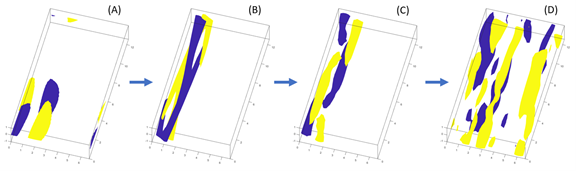
Recent observations show that substantial reductions in turbulent fluid drag can be made in turbulent boundary layers by introducing spanwise oscillation at the fluid boundary. From a dynamical systems viewpoint, it appears that the boundary oscillation excites certain invariant solutions (such as steady states or periodic orbits) which exert less drag on the boundary; the chaotic trajectory then visits these invariant solutions more frequently than it would otherwise, thus reducing the long-term turbulent drag. We are investigating the effect of periodic forcing on chaotic dynamics. The figure shows fast and slow streaks in a Couette shearing cell, starting with the smallest amplitude perturbation that can lead to turbulence(A), its evolution towards a steady-state saddle point(B), instability of this saddle point(C) and finally to fully developed turbulence(D).

Diagram depicting stages A through to D of the process described

Stratified shear flows (Dr. Tom Eaves)

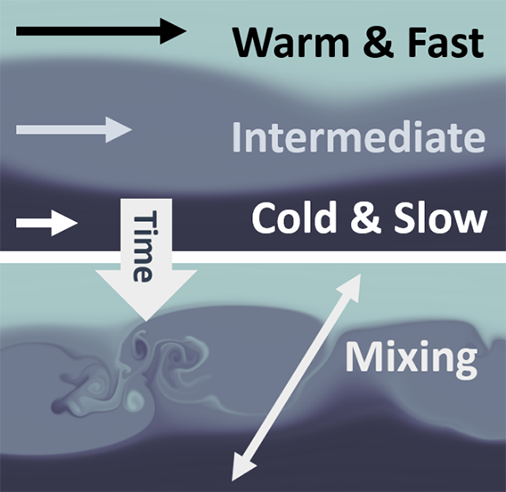
An understanding of the processes by which fluids of different densities are mixed in the ocean is crucial in order to properly constrain global climate circulation models. Local, rapid mixing processes are controlled by shear and density stratification, and such processes lie below the grid-scale resolution in climate models so that realistic parameterisation of this mixing is required. For such flows, there are three instabilities that can lead to mixing: the Kelvin–Helmholtz, Holmboe, and Taylor–Caulfield instabilities. The nonlinear evolution of each instability has distinct mixing characteristics, but it is not clear in what proportion each of these three mixing events occurs in the ocean. We use high-fidelity direct numerical simulation to help understand the dynamics of these instabilities, in order to better catalogue ocean data. The figure shows an example of the evolution of the Taylor-Caulfield instability.

Stratified shear flows diagram

Internal gravity wave-driven mixing (Dr. Anirban Guha)

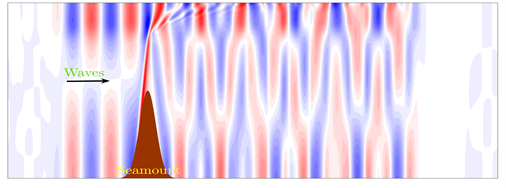
Small-scale (centimetre to the metre) mixing from oceanic internal gravity waves is essential for sustaining the Meridional overturning circulation and closing the global ocean energy budget. Weakly nonlinear wave-wave interactions and wave-(submarine)topography interactions are two of the primary mechanisms through which internal gravity waves' energy cascades to small length scales, thus leading to turbulence and mixing. We use high-resolution computational fluid dynamics simulations to study wave-wave and wave-topography interactions in realistic oceanic scenarios. The figure shows an internal gravity wave-topography interaction in the presence of a steady surface current.

Internal Gravity Wave-driven mixing diagram

Wave-current-wind interaction with floating offshore wind turbines (Dr. Masoud Hayatdavoodi)

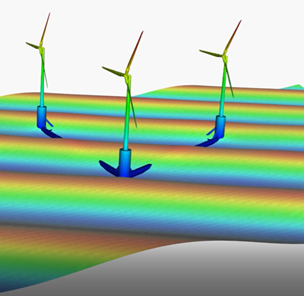
Floating offshore wind turbines are typically under the action of three types of external loads, namely (i) hydrodynamic loads due to waves and current, (ii) aerodynamic loads due to wind, and (iii) restoring loads due to the mooring lines attached to the seabed. Responses of structures to these environmental loads include (i) translational and rotational motions of the floating body, and (ii) the elastic deformations. We have developed computational models to determine coupled wave-wind-current loads on floating structures and analyse their motion and elastic responses.

Wave-current-wind interaction with floating offshore wind turbines diagram

SMART Laboratory

The Scottish Marine And Renewables Test (SMART) Centre.

Fulton Building

DD1 4HR

.
.
School of Science and Engineering Civil Engineering Research facility

About 

The laboratory provides modern materials testing facilities optimised for seabed geomaterials (soils and rocks), structural materials (e.g. reinforced concrete), and the interfaces between them.

Equipment and facilities

  • X-Ray micro CT imaging facility
  • High-speed imaging system (up to 6000 fps)
  • X-Ray diffraction
  • Cyclic Instron Load Frame
  • High speed stress-path triaxial apparatus with bender elements
  • Variable Direction Cyclic Simple Shear (VDCSS) apparatus
  • Large displacement Interface shear test device (IST)
  • Dynamic direct shear for partially-saturated geomaterials
  • Micro-impact rig (erosion of tidal turbine blades)

Geotechnical Laboratory

We maintain a well-equipped geotechnical engineering laboratory for teaching and research support

View accessibility information for the Fulton Building at AccessAble

Fulton Building

DD1 4HR

.
.
School of Science and Engineering Civil Engineering Research facility

About 

We offer extensive facilities for element testing and physical modelling, including Scotland’s only geotechnical centrifuge facility.

Equipment and facilities

  • Geotechnical centrifuge
  • Independent linear actuators and containers for 1-g physical modelling
  • Instrumentation and mobile (modular) data acquisition
  • Triaxial cells
  • Stress path cell
  • Direct shear apparatus (conventional and large-volume/large-displacement)
  • Oedometer cells (including constant rate of strain)
  • Soil classification
  • Hydraulic presses for soil consolidation
  • Pluviation facilities
  • Access to advanced element test equipment through the SMART laboratory 
  • Numerical modelling and simulation (FEM/DEM)
Subscribe to