

Biomaterials Laboratory
Develop and evaluate new biomaterials and coatings
View detailed accessibility information for the Fulton Building on AccessAble
Biomaterials Lab F24
Fulton Building
DD1 4HR
.
.
Prof Qi Zhao
School of Science and Engineering
Biomedical Engineering
Research facility
About
Data-physics OCA-20 contact angle analyser
The high incidence of infections caused by the use of implanted biomedical devices, including catheters, bone fracture fixation pins and heart valves etc. has a severe impact on human health and health care costs with increased morbidity and mortality.
This facility is to allow you to develop and evaluate new biomaterials and coatings with anti-bacterial properties and to design and evaluate new anti-infective biomedical devices and implants.
Equipment and facilities
- Advanced coating systems
- Dataphysics OCA-20 contact angle analyser
- QCMD 300 quartz crystal microbalance
- Fluorescence microscopes
- Cell culture and bacterial adhesion test rigs
- Incubators
- Autoclave
- Flow chambers and urine flow systems;
- Dipping device for biofilm adhesion strength assays
- CorrTest Electrochemistry Workstation
- UV-spectrometer
- Fume cabinet
- Biological safety cabinet
Cell and Tissue Culture Laboratory
The laboratory gives a sterile working environment where you can grow/maintain cells and engineer tissues under the correct physiochemical conditions
View detailed accessibility information for the Fulton Building at AccessAble.
F2
Fulton Building
DD1 4HR
.
.
School of Science and Engineering
Biomedical Engineering
Research facility
About
The laboratory provides the equipment needed to accommodate sterile handling, incubation, sterilisation, storage and waste disposal.
Equipment and facilities
- Biohazard laminar flow hood
- 2x Co2 incubators
- Autoclave
- Vacuum aspiration system
- Bench centrifuge
- Automated and manual cell counting facilities (Chemometec NucleoCounter® NC-250™ and haemocytometers)
- 10L water bath
- Portable UV light
- Inverted microscope
- Distilled water, Ethanol, Virkon and other cleaning products
- Biohazard waste bins and sharps bins
- pH meter
- 1-1000µl pipettes, automatic Pipette filler and serological pipettes (5-25ml)
- Culture dishes (35mm, 100mm & 150mm), T25 & T75 Culture flasks
- Refrigerator, freezers (-4oC, -20 oC and -70 oC), as well as a liquid nitrogen dewar
- Bio-rad Western Blotting System
IncuCyte facility for biomedical research
A Live-Cell Analysis System which enables real-time, quantitative live-cell assays within a tissue culture incubator.

Jacquie Wood Cancer Centre
James Arrott Drive
Ninewells Hospital & Medical School
Dundee
DD1 9SY
.
.
Dr Lindsay Spender
+44 (0)1382 381004
School of Medicine
Research facility
Available for internal users
Available for all University of Dundee researchers only
About
The IncuCyte® Live-Cell Analysis System enables real-time, quantitative live-cell assays within a tissue culture incubator. The walk-away automation also allows you to gather more information in a faster or more efficient way. An IncuCyte S3 and a new IncuCyte SX5 are available to all University of Dundee researchers for real-time imaging in phase contrast and Green and Red fluorescence.
The facility offers:
- Proliferation
- Migration
- Invasion
- Co-culture assays
- Organoid culture analysis
- Label-free cell-health analysed by AI
- ATP metabolism
- cell-by-cell analysis
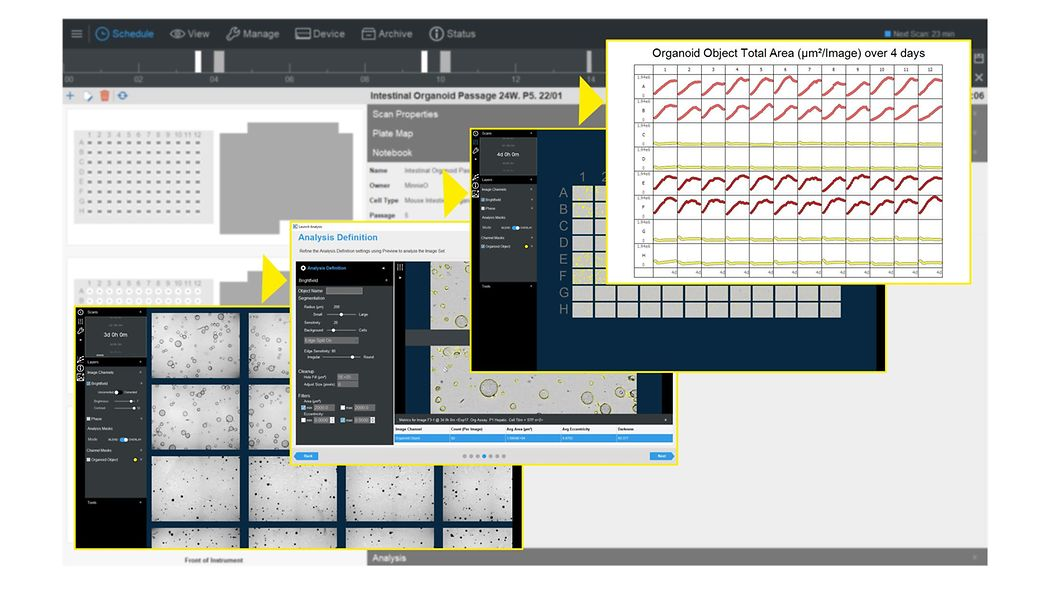
Measure treatment effects automatically and non-invasively. IncuCyte cell proliferation assays allow every well of a 96/384 well plate to be imaged and analyzed automatically to provide a microplate readout of cell proliferation over time. Proliferation time-courses reveal concentration-dependent treatment effects. Transform data into concentration-response curves to compare pharmacology.
Resources
Information, training, and bookings
If you’d like to find out more about the facility, please get in touch with Dr Lindsay Spender to discuss training and bookings. Charges apply for use of the machines.
Academic Lead: Dr James Cantley
Immunoassay Biomarker Core Laboratory
This facility handles, processes and analyses blood samples for biomarkers using various immunoassay techniques

Mailbox 6
L6/094
School of Medicine
Ninewells Hospital
Dundee
DD1 9SY
About
The Immunoassay Biomarker Core Laboratory provides immunoassay determinations of biomarkers in biological fluids, specimen processing and sample logistics for both internal and external collaborators across a variety of therapeutic indications.
All staff members have current Good Clinical Practice (GCP) certificates and have attended both GLP and GCLP training courses. The laboratory follows GCP for laboratories principles and participates in Quality Assurance audits.
We can provide help and advice on the selection and performance of immunoassays. Sample requirements and handling for optimal results.
We can offer a full service to measure samples for you or provide training on using some the instruments thereafter only usage charges applied.
Equipment & Facilities
Biomarker measurement methods include enzyme-linked immuno-sorbent assays (ELISA) luminescence or fluorescence assays (including HTRF [Homogeneous Time Resolved Fluorescence]), multiplex assays up to 100 biomarkers and ultra-sensitivity assays.
- Bio-Rad Bio-plex 200 [Luminex 200]
- Meso Scale Discovery (MSD) Quickplex SQ120
- Tecan Spark Multimodal Plate Reader
- Fluid X XSP-200 liquid handling and sample formatting station
- Thermo Scientific Multi-drop Regent Dispenser
- Point of care testing platforms
- Various dedicated Immunoassay auxiliary equipment
Get a quote or discuss projects
If you have any queries or looking for quotes, please contact Cheryl Wood ([email protected]) or Abirami Veluchamy ([email protected]) or Sharon King ([email protected]).
Geolocation
56.464204056861, -3.0389963262394
Health Informatics Centre
HIC Services supports high impact research through the collection and management of population based data.
HIC
Wilson House
1 Wurzburg Loan
Dundee MediPark
Dundee DD2 1FD
.
.
Health Informatics Centre
School of Medicine
Research facility
About
The Health Informatics Centre (HIC), based within the School of Medicine at Ninewells Hospital and Medical School, The University of Dundee is an ISO27001 accredited, Scottish Government regional ‘Safe Haven’ or ‘Trusted Research Environment’(TRE). HIC have also successfully completed the essential DSPT assessment against the National Data Guardian’s 10 stringent data security standards.
This means that HIC facilitate, as trusted data custodians, the safe, efficient and governance managed use of de-identified health data on behalf of the NHS and Scottish Government for legitimate research use. HIC maintains, as a data processor, anonymised records for approximately 20% of the Scottish population, in particular the health boards of Tayside and Fife. This is providing ‘big-data’ scale expertise and technical compute systems for research alongside the development of tools for future use within the clinical systems and collaboration with industry partners. Our team are managing population data for over one million patient records extending back approximately 30 years.
These data are governed, curated and managed by HIC as a trusted partner to enable timely, secure researcher access to specified cohorts and data linkage. This has been implemented for the last 5 years by the use of a virtual and controlled environment under ISO27001 provisioned for researchers who have been through MRC based research governance training. HIC has operated throughout this period a "Five Safes" approach which is a core principal of HDR UK which HIC implements as an Alliance member:
- Safe People: Technical skills to use the data; compliance training; confidentiality agreements
- Safe Projects: Research appropriateness; ethical; will benefit public; research published
- Safe Setting: Researcher only access; controlled virtual environment; no data distribution
- Safe Outputs: Export of results controlled for publication; confidentiality maintained
- Safe Data: Data within the controlled environment is de-identified
This research managed process is supported by HIC’s secure data and infrastructure team and governance manager with external support from the respective partner health boards and layperson representation.
HIC maintains a unique position in our adaptability to solve research questions and tackle problems at the forefront of data science. This is because the data custodianship is allied to a strong in-house software development and infrastructure team. In short, HIC combines secure data management/software development and academic research to tackle the development of data science applications for health, social care and associated data.
Visit Health Informatics Centre, TRE and the Discovery Portal for more information.
Geolocation
56.464888678564, -3.0460625365584