Artists
Sam Ainsley (RSA) is an artist and teacher and until 2005 was Head of the Master of Fine Art (MFA) programme at Glasgow School of Art (GSA). She has forged a remarkable career within the visual arts sector nationally and internationally. From 1985 to 1991 she taught on the Environmental Art programme when she then co-founded the MFA course. She has since worked collaboratively with David Harding (ex Head of Environmental Art at GSA) and Sandy Moffat (ex Head of Painting at GSA) as AHM (Ainsley, Harding, Moffat) on symposia and other events and continues to work independently in her studio.
She is a respected and published spokeswoman for the visual arts and her own artwork is held by a number of public and private collections nationally and internationally. Ainsley has contributed to a broad range of visual art initiatives in Scotland and has served as a Board member for many arts organisations. She has exhibited in and curated independent exhibitions and undertaken residencies in numerous institutions and arts organisations across the USA, Australasia, Europe and the UK.
In 2017 Ainsley was inducted into the 'Outstanding Women of Scotland' by the Saltire Society. GSA awarded her an Honorary Doctorate (DLitt) for her contribution to art and art education in 2018. In 2022 Ainsley had a solo exhibition titled Stories Real and Imagined in the Academicians' Gallery at the Royal Scottish Academy. In 2023-24, a major exhibition of her work is being held at the Gallery of Modern Art in Glasgow; the exhibition continues until June 2024.
—
For Outside the Circle, Ainsley collaborated with her former MFA student Anne-Marie Copestake to make a new artist’s film commission entitled 2024: Circle of Strength. Ainsley also presents two silkscreen print works in the exhibition, Reaping the Whirlwind (1987); and Passion, Imagination Consequence (1987). A manifesto was written by Ainsley especially for the collective performance of Feminist and Queer Manifestos reading, Voicing Outside the Circle at the exhibition opening where Ainsley compèred the performance.
An audio recording of Ainsley in conversation with Adele Patrick is also featured in the exhibition, this reflects on the intention and impact of a series of Gender Workshops Ainsley invited Patrick to deliver as part of the Environmental Art course curriculum at GSA in 1985.
In a monograph on Anne Bean's work, Self Etc., 2018, the writer Dominic Johnson wrote: 'Anne Bean is a noted international figure who has been working actively since the 1960s. The art of Anne Bean makes strange our sense of time, memory, language, the body, and identity, particularly through solo and collaborative performances along a vital continuum between art and life.'
Between 2022 and 2023 Anne Bean was commissioned and shown at Turner Contemporary, Margate, the Hatton Gallery, Newcastle, Cooper Gallery, Dundee, Somerset House, the Whitechapel Gallery, Matt’s Gallery, Paris Photo, Photo London, as well as a solo show with England & Co at Frieze Masters. In 2023 a major work was commissioned for the Norfolk Festival In Search of the Miraculous, with a resulting exhibition at England & Co, London. A large-scale light-work Reflect was created for Lumiere, Durham 2023. Recently, Tate purchased her work ‘Heat,’ part of Women in Revolt! (2023-2024). Bow Gamelan Ensemble (1983-1990) secured a Recollect: Artists, Legacies, Futures 2024 award. Her drawing This is the Zambian Pavilion is currently part of the Venice Biennale.
Bean was featured in Cooper Gallery’s two-chapter exhibition Of Other Spaces: Where Does Gesture Become Event? in 2016-17. Exploring the collaborative and subversive spirit of women artists’ endeavours between 1970–1990, the exhibition evoked a feminist ethos for an alternative politics in culture and society.
annebeanarchive.com
—
For Outside the Circle Anne Bean presents video, ephemera and photographs from art school and artist collaborations including with the Kipper Kids and the art parody band, Moody & the Menstruators (1971-74) initiated by Bean with fellow students from the Fine Art department of Reading University. In a series of theatrical and witty performances, the band covered songs such as Wild Thing by The Troggs (1966).
The group received broad interest and press attention as they toured Europe parodying sexist tropes, gendered expectations and testing the boundaries between high and low cultural forms that informed gender, androgyny and sexuality.
Sutapa Biswas is an artist who works across a range of disciplines including painting, drawing, film, video, and photography. Born in India and educated in the UK, she now lives and works in London. Her works possess a stark but poetic resonance. Drawing from her training in art history as well as from literary sources and postcolonial writers and thinkers, her art is shaped by her interest in the human condition, and how larger historical narratives from across the globe collide with the often-undocumented personal stories. Her practice questions the complexities of racial and gendered power relations born out of tangled colonial histories – especially, but not exclusively, regarding India and Europe. Like thread unravelling and ravelling in fabric, Biswas’ practice weaves conceptually across time and space, inviting the viewer to speculate on constructions of their own identity in relation to the themes within her art.
Biswas graduated with a BA Honours in Fine Art with Art History from the University of Leeds (1985), completed her postgraduate degree at the Slade School of Art (1990), and was a research student at the RCA, London (1995-1998). A key figure within the Black British Arts Movement, Biswas came to prominence immediately following her graduation when her iconic works including Housewives with Steak-knives (1984-1985), and Kali (1983-1985) – now in collections at Cartwright Hall, Bradford Museums, and Tate, respectively - were immediately selected for the landmark exhibition curated by Lubaina Himid, Thin Black Line (1985) hosted at the ICA, London.
Biswas’ works have been exhibited internationally and are widely reviewed. She recently held major UK solo exhibitions at Kettle’s Yard, Cambridge University, BALTIC, Gateshead, and Autograph, London. Other venues that have hosted her works include Tate Modern, Tate Britain, Yale University Art Gallery (New Haven), The British Museum, the 6th Havana Biennial, Neuberger Museum (New York), and the Art Gallery of Ontario (Toronto), Iniva (UK), and Reed Gallery (USA). She is a European Photography Award 1994 nominee and a Fellow of Yale University (2019-2020). Her film Lumen received the Art Fund Award 2019 – a co-commission between FVU (London), Bristol Museum & Art Gallery. Her artworks are held in public collections including TATE, the Government Art Collection (UK), Arts Council England, Reed Gallery (USA), Graves Gallery, Sheffield Museums and Galleries (UK).
—
For Outside the Circle, Biswas presents her video work Kali and archival materials in relation to her involvement in the British Black Arts Movement.
Kali (1983-1985) was the first video work made by Biswas, whilst an undergraduate student at the University of Leeds. Kali documents a performance Biswas staged with Isabella Tracy. The artists play themselves and the characters Kali and Ravan from Hindu mythology, whilst art historian Griselda Pollock, Biswas’ then tutor sits on a chair wearing a hood to witness the events unfolding. Pollok later recounted “Obliged to sit in the centre of a circle, hooded, though I could see through the slits at eye level, I was made to function as an icon of imperialism around which Biswas's enactments of resistance would be performed.” As a student Biswas challenged Pollock for not engaging meaningfully with issues of race and colonialism while making space for discussion of gender and class. This exchange led Pollock to radically revise the Leeds University art history syllabus.
Sheba Chhachhi is an installation artist/ photographer who investigates questions of gender, eco-philosophy, violence and visual cultures, with emphasis on the recuperation of cultural memory. An activist/photographer through the '80s-90s, Chhachhi's works are an amalgamation of her artistic vision, her feminism, and decades of involvement in the women’s movement in India. Through intimate, sensorial multimedia installations her work seeks to bring the contemplative into the political. She has exhibited widely including the Gwangju, Taipei, Moscow, Singapore and Havana biennales; her works are held in significant public and private collections, including MOMA New York, Tate Modern, UK, Kiran Nadar Museum, Delhi, Bose Pacia, New York , Singapore Art Museum , Devi Art Foundation, Delhi and National Gallery of Modern Art, India. She was awarded the Juror’s Prize for contemporary art in Asia by the Singapore Art Museum in 2011 and in 2018 the Thun Prize for Art & Ethics. Chhachhi speaks, writes and teaches in both institutional and non-formal contexts. She lives and works in New Delhi.
—
In the series From the Barricades: Excerpts from Resistance Chronicles: The autonomous women’s movement (Delhi 1980s- 90s) selected for Outside the Circle, Chhachhi revisits her archive of documentary images made between 1980 and the mid-90s and explores the construction of subjectivities and collectivity in resistance movements. The photographs include images from the Anti-Dowry movement in New Delhi, which peaked in the early 1980s, gaining momentum after the dowry-related femicides of Shashi Bala and Jaswanti. The Anti Dowry Campaign led to legislation, the establishment of women’s cells in the city, as well as general social stigmatization of the practice. While many of the images from this series document the Indian anti-dowry movement, others depict Indian women's demonstrations and awareness-raising campaigns against various other forms of oppression, such as rape, religious fundamentalism, domestic violence, and state violence. Key figures of Indian women’s rights activism appear in Chhachhi’s photographs, included in this selection are: Moloyashree Hashmi, a performer who co-founded the Jan Natya Manch New Delhi street theatre company; and Maya Krishna Rao who is a theatre and street performer, educator and activist.
Chhachhi also presents two posters of The Women’s Movement in India in the 1980s, and an audio piece of three feminist songs from Todo Bandhan—Breaking Barriers, recorded in 1985 narrated by Chhachhi and loaned from MoMA in New York.
Phyllis Christopher is a photographer whose work documenting LGBTQ visibility, sexuality and protest has been published widely in anthologies and magazines such as Nothing But The Girl: The Blatant Lesbian Image (co-edited by Susie Bright and Jill Posener), Photo Sex: Fine Art Sexual Photography Comes of Age (edited by David Steinberg), Art & Queer Culture (co-edited by Catherine Lord and Richard Meyer) Aperture Magazine, and Dark Room: San Francisco Sex and Protest, 1988-2002 (edited by Laura Guy) in 2022.
Christopher is the former photo editor the revolutionary lesbian magazine On Our Backs magazine. In 2005, she released the DVD Sextrospective: A Decade with San Francisco’s Sexiest Lesbians – a collection of 280 photographs documenting the lesbian sexual revolution of the 1990’s. She has been featured on HBO’s Sexbites, Canadian television’s Sex TV and the documentary film, Erotica – A Journey into Female Sexuality. In January 2017, her work was featured in the retrospective: On Our Backs: An Archive (The Newbridge Project Gallery, Newcastle), and in 2019 at Still I Rise: Feminisms, Gender, Resistance (Nottingham Contemporary). She is a 2020 finalist of Queer|Art’s, Robert Giard Grant for Emerging LGBTQ+ Photographers. In 2021, her work was the subject of a major retrospective organised between BALTIC Centre for Contemporary Art, Gateshead, and Grand Union, Birmingham. In 2022 her book was shortlisted for Aperture’s photo book of the year and is now in their permanent library.
Christopher lives in England where she conducts workshops, co-facilitates a community darkroom at the NewBridge project, and continues to document the LGBTQ+ community.
phyllischristopher.com
––
For Outside the Circle Christopher presents a series of archival photographic works taken during the artist’s participation in the LGBTQ+ street protests in San Francisco in the 1980s and1990s alongside her test strip collage works; a unique artistic expression Christopher has developed that contextualises and expands the vocabulary and gesture of her photographic works. Also included in the exhibition are queer zines and publications with the artist’s photography featured on the covers from Christopher’s archive.
Anne-Marie Copestake is an artist living in Glasgow. Attentive to temporary and longer term communities, daily acts, acts of refusal, narrative and emotion, her work is concerned with entangled social political conditions surrounding choices, or lack of choices, and an exploration of histories and environments that may have contributed. She often works collaboratively, recently with musician Ailbhe Nic Oireachtaigh.
—
For Outside the Circle, Anne-Marie Copestake collaborated with Sam Ainsley to make a new artist’s film commission entitled 2024: Circle of Strength.
Steve Farrer is UK based visual artist and experimental film maker who uses camera equipment salvaged from old British film productions.
—
Farrer's artist’s film Kiss 25 Goodbye (1991) featured in Outside the Circle documents the OutRage! Kiss-In protest at Bow Street police station in London, an action and demonstration against homophobic government bill clause 25/28.
Margaret Harrison is a feminist and artist whose work uses a variety of media and subject matter. She currently works between the United States (San Francisco) and England (Carlisle, Cumbria), where she has had solo exhibitions, notably at the New Museum in New York and the Middlesbrough Institute of Modern Art.
Harrison founded the London Women's Liberation Art Group in 1970. Between 1973 and 1975 she collaborated with artists Kay Hunt and Mary Kelly to conduct a study of women's work in a metal box factory in Bermondsey, London. They presented their findings in 1975 in the installation Women and Work: A Document on the Division of Labour in Industry 1973–1975 that was first displayed at the South London Art Gallery in 1975. Her work was included in the exhibition Issue: Social Strategies by Women Artists, curated by Lucy R. Lippard, at the Institute of Contemporary Arts, London in 1980. This important international group exhibition highlighted socially oriented feminist art practice and has been recognized as a key feminist exhibition.
Harrison has had major retrospectives at BPS22, Belgium, and FRAC Lorraine, Metz, in 2019. In 2017, the Azkuna Zentroa art centre in Bilbao also dedicated a solo exhibition to her. She has participated in several group exhibitions at international institutions such as the Tate Modern, Tate Britain and the Victoria and Albert Museum in London, MOCA in Los Angeles and the Museu do Chiado in Portugal, among others.
In 2013, she was awarded the Northern Art Prize for “vital new works that reflects on her 50-year career at the front line of art and activism.”
Harrison was featured in Cooper Gallery’s two-chapter exhibition Of Other Spaces: Where Does Gesture Become Event? in 2016-17. Exploring the collaborative and subversive spirit of women artists’ endeavours between 1970–1990, the exhibition evoked a feminist ethos for an alternative politics in culture and society.
—
Harrison was an activist at Greenham Common Women's Peace Camp, this experience had a significant impact on her life and art. Featured in Outside the Circle is Harrison’s installation Common Land/Greenham (1989) which was created during her Artist’s Residency at the New Museum in New York in 1989 with the intention to raise the awareness in USA of the Greenham Common Women's Peace Camp in the UK.
Consisting of images, newspaper clippings, women's testimonials and historical records, the piece is an inquiry into the various histories and ideologies of ‘land’ that lie in the phrase ‘land-based nuclear missiles’ and underscores the interrelation of the two tales of Greenham Common, situating political praxis in terms of its most seemingly mundane effects, and identifying art as signal means of civil disobedience.
Barbara Howey, Carol Massey Lingard and Jenny Stevens were part of the first intake of students on the newly launched MA in Feminism and the Visual Arts (known as MAFEM) at the University of Leeds established by Griselda Pollock in 1992. Its aim was to recruit artists, art historians and potential writers and curators to work together across three components: feminist cultural theory, feminist analyses of twentieth century art, contemporary feminist artistic, critical and curatorial practice. While all students had to engage with academic study, their dissertations could take practice-based or academic form.
––
Featured in Outside the Circle is a sculptural installation by Barbara Howey, Carol Massey Lingard and Jenny Stevens entitled A Conversation With Others (1993) which was made as a statement about their experience as working class women students and artists entering in the normatively white, middle class academic environment on the MAFEM course. The piece was loaned to the exhibition through Griselda Pollock.
Alexis Hunter (1948–2014) was an artist who explored feminist theory and the power of representation with photography, film, text and painting. After studying at the Elam School of Fine Arts, Auckland (1966-69), Hunter joined her sister in London in the early 1970s.
“Finding that "it was too hard to be a feminist artist on your own; the criticism was too great to bear", Hunter joined the Artists Union Women's Workshop in London in 1972, alongside the feminist photographers and film-makers Tina Keane, Mary Kelly, Margaret Harrison and Annabel Nicolson.” (Lynda Morris, 2014)
An active member of both the Artists Union Women’s Workshop and the Woman’s Free Arts Alliance in the '70s, Hunter was influenced by the Women’s Liberation Movement stance against patriarchy and used art as a tool to explore everything from capitalism, the male-dominated advertising industry, contemporary politics and feminism. Through the use of series and narrative sequences, she exposed the tyranny of fashion, domestic violence and the exploitation of women and social constructs of gender.
Hunter was included in the important exhibition curated by Lucy Lippard at the ICA in London, entitled Issue: Social Strategies by Women Artists in 1980. Since 2006 her photographic work has been introduced to a new generation. Her work has been shown in Alexis Hunter: Radical Feminism in the 1970s at the Norwich University of Arts Gallery, WACK! Art and the Feminist Revolution, a touring survey exhibition in major venues across the United States (2007), and Sexual Warfare, a solo exhibition that inaugurated the Goldsmiths Centre for Contemporary Art (2017).
Hunter was featured in Cooper Gallery’s two-chapter exhibition Of Other Spaces: Where Does Gesture Become Event? in 2016-17. Exploring the collaborative and subversive spirit of women artists’ endeavours between 1970–1990, the exhibition evoked a feminist ethos for an alternative politics in culture and society.
alexishuntertrust.org
—
Hunter's collage Sexual Warfare (1973) highlighting the use of violent language and imagery circulating in the public discourse around feminism at the time, and hand-coloured Xerox prints The Media (1968) critiquing the representation of women and their political endeavour in the capitalist mass media are featured in Outside the Circle, loaned from Richard Saltoun Gallery.
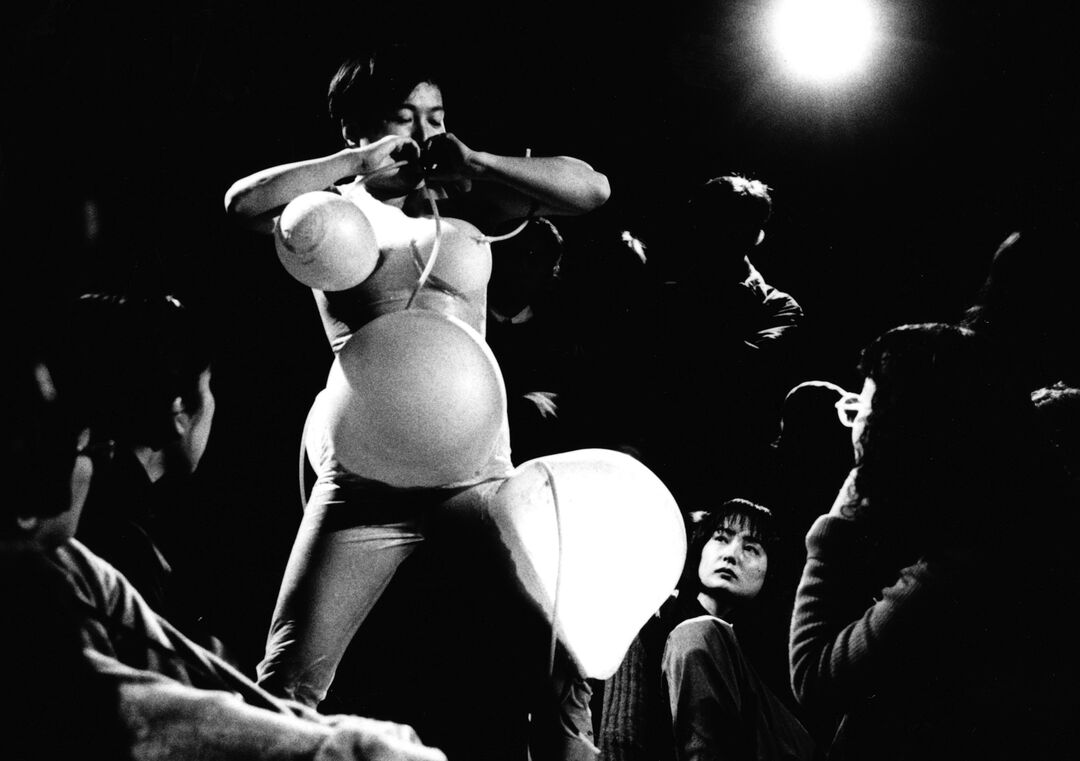
Tari Ito (1951-2021) was a performance artist and activist based in Tokyo, Japan. With a background in pantomime and theatre, Ito turned to performance art as a medium to explore sexuality, military sexual violence, nuclear disasters, and personal identity. The founder of the Women’s Art Network in Tokyo, Ito’s performances frequently reflected on female and LGBTQ+ sexuality and identity.
In 1994, she established the feminist artist collective Women’s Art Network, which organized exhibitions with the Feminist Art Action Brigade, such as 'Women Breaking Boundaries' (2001) and 'Borderline Cases' (2005). In 2003, she launched PA/F SPACE, located near Tokyo’s Waseda University, to provide workshops and support for the LGBTQ community in Japan. As an artist, she participated in several projects that centred woman practitioners, such as the international art summit Womanifesto in Bangkok, in both 1997 and 1999. In January 1996, Ito openly declared herself a lesbian in her most ground-breaking performance, Self Portrait.
ipamia.net/en/
—
A photographic documentation of Tari Ito's Self Portrait by Ayano Shibata is used for the exhibition poster and featured in Outside the Circle alongside the video documentation of Ito's two pioneering performances Self Portrait (1996) and Me Being Me (1999), as well as ephemeral material in relation to Tari Ito’s practice both as an artist and organiser, loaned from IPAMIA Archive in Japan.
Derek Jarman (1942-1994) was an artist and filmmaker, best known for his avant-garde art films and also renowned as a set designer, gardener, author and gay rights activist. During the 80s, Jarman was a leading campaigner against Clause 28 (also known as Section 28), legislation introduced by the government of Margaret Thatcher that banned the "promotion" of homosexuality in UK schools. He also worked to raise awareness of HIV and AIDS during the epidemic of the 1980s, himself having been diagnosed as HIV positive in December 1986.
In 2008, Film London established the Jarman Award. Dedicated to Derek Jarman’s legacy, it celebrates the spirit of experimentation, imagination and innovation in the work of artist filmmakers in the UK.
—
Featured in Outside the Circle is one of Jarman’s Slogan paintings. Titled Act Up (1992) this large canvas makes passionate reference to the AIDS Coalition to Unleash Power campaign and a heartfelt need to address the prejudice against Aids sufferers and the homophobia that was still prevalent in the early 1990s. Having been diagnosed as HIV positive in 1986, Jarman was one of the first figures who spoke publicly about the virus. Act Up formed in 1987 at the Lesbian and Gay Community Services Centre, New York to end the AIDS pandemic and improve the lives of people with AIDS through historic direct action, live saving medical research, treatment and advocacy, and working to change legislation and public policies.
Jarman is featured in Steve Mayes' OutRage! photographs shown in Outside the Circle. In 1992 along with Scottish Pop singer and songwriter Jammie Somerville and co-founder of OutRage! Peter Tatchell, Jarman took part in OutRage's Equality Now! protest in which they and over 50 others were arrested while trying to march on parliament to demand the repeal of anti-LGBT+ laws.
An artist’s film by Stephen Farrer, Kiss 25 Goodbye (1991) documenting Jarman participating the OutRage! Kiss-In protest at Bow Street police station in London can be viewed in Outside the Circle.
Mary Kelly is known for her project-based work, addressing questions of sexuality, identity and historical memory in the form of large-scale narrative installations. In 1968 she began her long-term critique of conceptualism, informed by the feminist theory of the early Women’s Movement in which she was actively involved throughout the 1970s. She was a member of the Berwick Street Film Collective and a founder of the Artistsʼ Union. During this time, she collaborated on the film, Nightcleaners, 1970-75, and the installation, Women & Work: a document on the division of labor in industry, 1975, as well as producing her iconic work on the mother/child relationship, Post-Partum Document, 1973-79.
More recently, she has turned to the theme of collective memory. A retrospective her work was organized by Whitworth Art Gallery, Manchester, 2011. Major surveys were presented at Moderna Museet, Stockholm, 2010 and Centre for Contemporary Art, Warsaw, 2008. From 1996-2017, Kelly was Distinguished Professor of Art at the School of the Arts and Architecture, University of California, Los Angeles, where she founded the Interdisciplinary Studio Area.
Kelly was featured in Cooper Gallery’s two-chapter exhibition Of Other Spaces: Where Does Gesture Become Event? in 2016-17. Exploring the collaborative and subversive spirit of women artists’ endeavours between 1970–1990, the exhibition evoked a feminist ethos for an alternative politics in culture and society.
marykellyartist.com
—
Featured in Outside the Circle is Kelly’s WLM Demo Remix (2005), a video-loop with a slow dissolve to create a bridge between past and present representations of the 1970 Women’s Liberation demonstration in New York, which marked the 50th anniversary of the Nineteenth Amendment. The overlaid images synthesize past and present, exploring the ongoing investment of the artist and performers in both the history and current relevance of sexual politics.
Suzanne Lacy is renowned as a pioneer in socially engaged and public performance art. Her installations, videos, and performances deal with sexual violence, rural and urban poverty, incarceration, labour and aging. Lacy’s large-scale projects span the globe, including England, Colombia, Ecuador, Spain, Ireland and the U.S.
In 2019 she had a career retrospective at the San Francisco Museum of Modern Art and at Yerba Buena Art Center. Her work has been reviewed in major periodicals and books and she exhibits in museums across the world. Also known for her writing, Lacy edited Mapping the Terrain: New Genre Public Art and authored Leaving Art: Writings on Performance, Politics, and Publics, 1974-2007. She is a professor at the Roski School of Art and Design at the University of Southern California and a resident artist at 18th Street Arts Centre.
suzannelacy.com
—
For Outside the Circle, Suzanne Lacy presents an archival installation developed from the participatory project School for Revolutionary Girls (2016) at Irish Museum of Modern Art, a collaboration between Lacy and Nicola Goode.
School for Revolutionary Girls was a ten-day project with teenage girls who explored their relationship to the 1916 Rising of the Irish revolution and to contemporary issues facing young women in Ireland and around the world. This artistic "consciousness- raising" process combined group discussion, performance, and social media and a reading of manifestos in the courtyard of the museum. Working with historian, Liz Gelles, international students, Irish and US artists, and CREATE, they imagined the world as it is, and will be, developing creative expressions of their own unique "public voice."
Katharine Meynell is an artist working in video, performance and small publications. Her interests concern the personal & the political, humour, feminist strategies and the slippery line between document and fiction. Her work has been presented at: Tate Liverpool; Cornerhouse, Manchester, Kettles Yard, Cambridge; Bluecoat, Liverpool; Film Museum, Amsterdam; LUX, London and included in many prestigious collections. She has worked in arts education since 1984. Publications include: Mutual Dependencies Artwords, 2011; It’s inside, Marion Boyars, 2005 (exhibition CPG/Wellcome Trust). Works in collaboration with the Gefn Press include: Cunning Chapters, British Library, 2007 and Poetry of Unknown Words, Poetry Library, London South Bank, 2012.
Meynell was featured in Cooper Gallery’s two-chapter exhibition Of Other Spaces: Where Does Gesture Become Event? in 2016-17.
katharinemeynell.co.uk
—
Shown in Outside the Circle is Meynell's, RCA Women's Group,1983. A short documentary of the Women's Group at Royal College of Art discussing the conditions for women students at the time. This film was made during Meynell’s time as a student in the Department of Environmental Media at RCA.
Annabel Nicolson is an artist, filmmaker and performer based in the Scottish Highlands, widely celebrated for her film performance works. She studied at Hornsey College of Art before moving to Edinburgh College of Art to study Drawing and Painting. She ran the gallery at New Arts Lab from 1969-70 and was later one of the few women members of London Film Maker’s Co-op where she was cinema programmer. She was a founding member of Circles - Women’s Film in Distribution. She has taught at many art colleges including Wimbledon and Falmouth and devised the Women in Art course at Chelsea College of Art (1987-88). From the 1970s onwards she has been producing film works, often on 16mm, as well as expanded cinematic performances which play on the elemental make-up of cinematic space.
She co-edited and published Readings magazine with Parul Burwell and was an editorial contributor for Musics magazine. Her work is in the collection of the Belgian National Film Archive and The British Film Institute and The Women’s Art Library.
Nicolson was featured in Cooper Gallery’s two-chapter exhibition Of Other Spaces: Where Does Gesture Become Event? in 2016-17. Exploring the collaborative and subversive spirit of women artists’ endeavours between 1970–1990, the exhibition evoked a feminist ethos for an alternative politics in culture and society.
—
Outside the Circle features audio, texts, ephemera and film by Nicolson. An artist’s publication reflecting on an early collaborative exhibition A Room of One’s Own (1984) at South Hill Park in Bracknell, is included, along with ephemera of Concerning Ourselves, an exhibition and communal space created with other women artists as part of Nicolson’s residency at Norwich School of Art in 1981, and Fire Film (1981), a super8 film made at the start of Greenham Common Women’s Peace Camp. An audio work, Message to All of You created for Cooper Gallery’s two-chapter exhibition Of Other Spaces: Where Does Gesture Become Event? (2016-17) is also presented in Outside the Circle.
Monica Ross (1950-2013) was an artist working with video, drawing, installation, text and performance. She came to prominence as a Feminist artist and organiser in the early 70s, through collective initiatives such as Feministo (1975-77/78), a collaborative postal art event that evolved into a travelling exhibition—most famously shown as Portrait of the Artist as a Housewife at the ICA, 1977; Kunstlerinnen International 1877-1977; Schloss Charlottenburg, Berlin, 1977—and the touring project Fenix (1978-80) with Kate Walker and Su Richardson. Both projects made visible the conditions and constraints of working-class female artists.
Ross was featured in Cooper Gallery’s two-chapter exhibition Of Other Spaces: Where Does Gesture Become Event? in 2016-17. Exploring the collaborative and subversive spirit of women artists’ endeavours between 1970–1990, the exhibition evoked a feminist ethos for an alternative politics in culture and society.
monicaross.org
—
Exhibited through documentation of an action, in Monument to Working Women (1985), we see the artists Shirley Cameron, Monica Ross and Evelyn Silver dressed in overalls, intervening in a public site where History – in the monument of John Bright, an influential industrialist – misrepresents the living memories of workers, specifically women workers, and their experience of the relations between labour and capital.
Ross’ text work; History or Not (2000), reflecting on the art, activism and relations of her women artist peers in the 70s & 80s, is featured in the exhibition alongside the audio read by her daughter Alice Ross.
Outside the Circle also includes the drawings and video of Ross’ celebrated work Anniversary—an act of memory (2008-13). Presented as solo, collective, and multilingual recitations from memory of the Universal Declaration of Human Rights, the piece was performed at sixty venues in the UK and abroad, concluding with a final performance at the Human Rights Council of United Nations in Geneva on 14 June 2013. It is Ross’ sincere hope that others may be encouraged and inspired to continue this endeavour to promote human rights throughout the world by using Anniversary—an act of memory as a model or template.
Georgina Starr is a British artist best known for her video, sound and performance artworks. She emerged in the early 90s with a series of complex works exploring fragile phenomena through audio, text and moving image. With a focus on female identity, memory, alchemy and film history she creates multi-layered theatrical events, sculptural installations, films and fictions. Described as ‘Magically complex works that challenge the viewer to re-examine the self, the unconscious and its ever-morphing biographies through a glittering and melancholic theatre of memory, mythology and fiction.’
Starr's works have been exhibited widely over the last 30 years in galleries and museums both in the UK and internationally, from the Museum of Contemporary Art Sydney and Tate Britain to Kunsthalle Zurich, Venice Biennale and Museum of Modern Art in New York. Recent exhibitions include the sculpture/performance commission Moment Memory Monument presented at Palazzo Reale, Milan, a survey exhibition Hello. Come here. I want you., Frac Franche-Comté and a live performance commission Androgynous Egg, Frieze Projects. Her latest film work Quarantaine was commissioned by Film & Video Umbrella (London), The Hunterian (Glasgow), Art Fund (Moving Image Fund), Glasgow International and Leeds Art Gallery. Starr was shortlisted for the Film London Jarman Award 2021. Starr’s solo exhibition Before Le Cerveau Affamé and performance Opening Ceremony were commissioned by and presented at Cooper Gallery, 2013. She was also featured in Cooper Gallery’s two-chapter exhibition Of Other Spaces: Where Does Gesture Become Event? in 2016-17. Exploring the collaborative and subversive spirit of women artists’ endeavours between 1970–1990, the exhibition evoked a feminist ethos for an alternative politics in culture and society.
georginastarr.com
—
Flesh, (Six Sculptures), 2008, a performance video by Starr features in Outside the Circle. In Starr’s literally iconoclastic action, six hand painted ceramic sculptures of partially nude but coy representations of ideal femininity are given to the gaze at a private view for the exhibition Event Horizon at the Royal Academy of Arts in London, 2008. Without announcement or warning Starr hoists each aloft before smashing them against walls and floors. This joyous shattering of demurely posed muses, mythological beauties and goddesses demonstrates Starr’s avowedly long-term feminist project of performing the ‘maternal.’
With the support of Georgina Starr, Outside the Circle features artworks and ephemera by pioneering gay artist Ronald Wright. Outside the Circle present two works by Starr made in collaboration with Wright; Looking at Ronaldo Wright (I am a Record), 2008, a 12” vinyl with collage artwork sleeve and Ronaldo Wright's Recollection of the Physique Magazine World, 2010, a 14 minute video.
Marlene Smith is an artist and curator and one of the founding members of Blk Art Group. She graduated from Bradford School of Art with a BA in Art & Design in 1987. She is currently a co-Leader (with Alice Correia and Lizzie Robles) of the Black British Art Research Group/British Art Network, a Tate initiative. She was co-curator for Nations’s Finest, Putting Down Roots & Birthing (2021-2022) and associate Making Histories Visible archive, UCLAN, (University of Central Lancashire), Preston, (2017–2020); UK Research Manager for Black Artists and Modernism, University of the Arts London (2015 -2017) and Director of Public Gallery, West Bromwich (2001-2009).
Selected exhibitions since 2017 include: Women In Revolt, Tate Britain + tour, 2023-2025, The More Things Change, Wolverhampton Art Gallery, Black Art Collection Highlights, Wolverhampton Art Gallery (2022); Cut & Mix, New Art Exchange, Nottingham (2022); Portals, East Side Projects, Birmingham; Get Up, Stand Up, Now! Generations of Black Creative Pioneers, Somerset House, London (2019); The Place is Here, Nottingham Contemporary and South London Gallery (2017); Thinking Back: a montage of black art in Britain, Van Abbe Museum, Eindhoven, Netherlands (2016); and Blood: Who Am I Gallery, Science Museum, London (2011).
Smith’s solo exhibition, Ah Sugar took place at Cubitt Gallery, London from 22 August–18 October 2024.
—
Smith presents her black and white photograph, Ad(dress) Rehearsal: Golda, 2014 along with ephemera from The Blk Art Group for Outside the Circle.
Jo Spence (1934–1992) was an artist, photographer, educator, cultural worker, writer and broadcaster central to the debates around photography, feminism and the critique of representation in the 70s & 80s. Starting out in commercial photography, Spence re-focussed her work on socialist and feminist themes in the 70s and latterly her own struggles with cancer, depicting various stages of illness, subverting the notion of idealised representations of women.
Spence had a lifelong collaboration with the photographer Terry Dennett and in 73’ they founded the Photography Workshop, an independent organisation dedicated to education, research and publishing, which included an exhibition space and resources for photographic production. She co-established the Hackney Flashers (1974–early 80s) and Polysnappers (1980–82). Spence often sought alternative distribution models, laminating work for durability and renting out her photography to conferences, libraries, universities and public spaces to broaden its audience.
Spence was featured in Cooper Gallery’s two-chapter exhibition Of Other Spaces: Where Does Gesture Become Event? in 2016-17. Exploring the collaborative and subversive spirit of women artists’ endeavours between 1970–1990, the exhibition evoked a feminist ethos for an alternative politics in culture and society.
—
Outside the Circle presents photographic work by and archives of Jo Spence. The Highest Product of Capitalism (1979) reflects on women’s social and economic options and her own work as a commercial photographer, and Remodelling Photo History (1981-82) made with Terry Dennett is a photography series emphasised staging and construction over the assumption of naturalism in the photographic image.
Maud Sulter (1960–2008) was an artist, photographer, writer, poet, educator and feminist of Scottish and Ghanaian heritage, who created spaces for the work of Black women through publishing and curating. Sulter started her career as a poet and published her first volume As a Blackwoman in 1985 and in the same year exhibited her artwork in The Thin Black Line, ICA, London, curated by Lubaina Himid—the first major exhibition to feature contemporary women artists of colour in a British public institution. In 1990 she published Passion: Discourses on Blackwomen’s Creativity through her own publishing house, Urban Fox Press, ‘a revolutionary new press for the more radical 90s’. This groundbreaking publication was the result of the Blackwomen’s Creativity Project, which she started with photographer Ingrid Pollard in the 1980s. She was active in the Black feminist and lesbian movements, often inspired by African-American activists, artists and writers. She curated numerous exhibitions, and set up a gallery, Rich Women of Zurich in Clerkenwell in London (1999-2000), to promote diversity and mid-career artists from her community.
As a member of the British Black Arts Movement, Sulter strove to place Black women at the centre of an art history that had excluded them. Her Zabat photography series from 1989 commissioned for Rochdale Art Gallery repurposed the conventions of Victorian portraiture to portray Black women as muses from Greek tradition, celebrating the cultural accomplishments of Black women and calls for a repositioning of Black women in the history of photography.
maudsulterpassion.wordpress.com
—
Clio, from Sulter’s Zabat series portrays poet Dorothea Smartt as Clio, the muse of heroic poetry and history is featured in Outside the Circle loaned from the McManus: Dundee’s Art Gallery & Museum, alongside of her writing and ephemeral material in relation to her practice as an artist, writer and publisher loaned from Sulter’s friend Ajamu X and Women’s Art Library at Goldsmiths.
Ronald Wright (1929–2020) was an artist, writer, model, magazine illustrator and spiritualist healer who blazed a trail for gay art. In the 1950s, Wright began drawing pictures of men for health and fitness magazines. In 1960, he launched a magazine of his own called Sir Gay; which he was later to be known by. Sir Gay was a groundbreaking magazine, published six years prior to the decriminalisation of homosexual acts between men over the age of 21 in England and Wales (to be followed 13 years later in Scotland in 1980).
At age 29 Wright was sentenced to 18 months in prison. He had been posing nude for a gay magazine, and a postal worker looked at his post, finding photos of Wright naked with his boyfriend which were being sent to a client. He was reported to the police who arrested Wright and his boyfriend. In the late 1970s Ron became a spiritualist and wrote a series of books on the subject. In 1990 he published his autobiography, Flesh: The Great Illusion and in 2014, Hertford Museum held a retrospective of his work which he attended. In 2020 artist Georgina Starr wrote Wright’s obituary for The Guardian.
—
Featured in Outside the Circle are Wright’s artworks and archives selected by Georgina Starr from Sir Gay Archive/Ronald Wright, Hertford Museum Collection. A video by Starr, Ronaldo Wright's Recollection of the Physique Magazine World (2010) derived from interviews Starr undertook with Wright is also included in the exhibition.
Ajamu X (HON FRPS) is a darkroom/fine art photographic artist. His practice places production, making and process at the centre of the work and his subject matter is similarly focused on sensuality. His images privilege those tangible/tactile sensuous elements of a socially engaged fine art practice currently at risk of being lost through the dematerialisation of culture. Through experimentation and risk-taking, the work literally/metaphorically rubs up against the flattening out of black queer creative practices to staid notions of identity - thinking and representation.
His work has been exhibited in many prestigious museums, galleries worldwide and alternative spaces worldwide. In 2022, he was canonised by The Trans Pennine Travelling Sisters/Sisters of Perpetual indulgence as the Patron Saint of Darkrooms and received an honorary fellowship from the Royal Photographic Society. His work sits within many private and public collections including: The Rose Art Museum, Gallery of Modern Art, Autograph, Tate Britain, Arts Council of England, and the Victoria & Albert Museum.
Ajamu X is also the co-founder of rukus! Federation and the rukus! Black Lesbian, Gay, Bisexual, Trans, Queer + Archive and one of a few leading specialists on Black British LGBTQ+ history, heritage, and cultural memory in the UK.
ajamu-studio.com
—
For Outside the Circle, Ajamu X presents two black and white photographs of defiant Black queer sexuality and sensuality. Self-Portrait #blackfreaksmatter (2020) and Bud Km (2018). These works are shown alongside ephemera from Ajamu X's archive and The rukus!, a Black British LGBTQ+ archive.
Performance Commission
nussatari is an interdisciplinary artist with a body-based practice across live performance / movement / sound / research / writing and facilitating. They are interested in unknowings and bodily knowings as sites of potentiality; in opacities, in parallel existences, imaginings; things and nothings and being and thinking, and doing. Commissions include The Centre of Somewhere residency with TMS/Centre for the Less Good Idea, Johannesburg (2023), ember (5.5) at Jupiter Rising 2022, hologram (10.7) with Transplant Imaginaries/CBSS/Being Human Festival (2021) and sendiri for Take Me Somewhere 2021.
nussatari’s wider work involves project producing, facilitating, community organising and advocacy with Queer, Trans, Black, Indigenous and People of Colour (QTBIPOC) community. They co-founded project ID.Y in 2018, a collaborative arts support entity centring anti-racism in practice in the arts. They initiated House Ball Scotland project as a values-based community support entity, advocacy with and connection point for QTBIPOC and the underground ballroom scene.
—
nussatari is developing a performance for Outside the Circle to be presented at the 12 Hour Acting Up symposium on 1 February 2025 at Cooper Gallery.