
Professor Kate Storey FRS, FMedSci, FRSE
Emeritus Professor of Neural Development
Molecular Cell and Developmental Biology, Faculty of Life Sciences
Contact
Biography
Kate Storey is emeritus chair of Neural Development in the Faculty of Life Sciences. Her research interests focus on the cellular and molecular mechanisms that regulate neural differentiation, most recently using human stem cell derived neural tissue assays.
Kate did her PhD at the University of Cambridge, UK, identifying annelid stem cells that generate the nervous system. In 1987 she extended this work as a post-doctoral Harkness fellow with David Weisblat at the University of California, Berkeley, USA. From 1990 Kate joined Claudio Stern’s lab at the University of Oxford, UK, where she localised the neural inducing abilities of the Organiser region in the chick embryo. She became a lecturer at the University of Oxford in 1994 and moved to the University of Dundee in 2000 on an MRC senior non-clinical fellowship. Major discoveries made by the Storey group include a fundamental signalling switch that controls the onset of neural differentiation in the developing vertebrate embryo, and a cell biological mechanism, apical abscission, which mediates the differentiation of newborn neurons. This research has been largely supported by the MRC and Wellcome see Storey lab website.
Kate is a fellow of the Royal Society, EMBO, the Royal Society of Edinburgh, and the Academy of Medical Sciences. She was awarded the MRC Suffrage Science Heirloom Award 2014, Royal Society Wolfson Research Merit Award 2015, and British Society for Developmental Biology’s Waddington Medal in 2019.
University roles
Kate served as Associate Dean of Research (2008-2010) and co-led the School’s successful BBSRC Impact with Excellence Award 2011. She was head of the Division of Cell and Developmental Biology for 12 years (2010-2022) and subsequently co-head of the merged Division of Molecular, Cell and Developmental Biology for ~ 1 year. She was one of four senior faculty responsible for the School of Life Sciences UoA5 REF submission 2014. Together with Dr Lindsay Davidson, Kate established a human pluripotent stem cell facility (2015) which supports research with these cells across the University and beyond.
Currently, Kate is an active emeritus professor at the University of Dundee. She provides oversight advice for the Faculty of Life Sciences Human Pluripotent Stem Cell Facility. She serves as the University of Dundee’s Academy of Medical Sciences Champion, with Professor David Horn, and provides mentorship for principal investigators across career stages.
External roles
Kate served on grant panels for Wellcome, MRC Neuroscience and Mental Health Board, BBSRC panel A, Dorothy Hodgkin Fellowships Panel, University Research Fellowships Panel for the Royal Society, Lister Institute Prize Scientific Advisory Board, Action for Medical Research, membership committees for EMBO and Royal Society of Edinburgh, and Scientific Advisory Boards including the MRC Centre for Neurodevelopmental Disorders and HDBI management group. She was a director of the Company of Biologists for 14 years, co-establishing their International Workshop series and developing sustainability and ethical investment initiatives.
Currently, Kate is vice-chair of the tissue bank Human Developmental Biology Resource (HDBR) steering committee (2018 - present). A contributor to Nuffield Council On Bioethics initiative on recommendations for research with human neural organoids. She is co-chair for Wellcome’s HDBI ethics seminars, a member of the Roslin Foundation Grants Advisory Committee and Royal Society Fellowship Search Committee 8 and Research Professorships Panel.
Research
Researchers in Kate Storey’s laboratory investigate how the vertebrate nervous system forms during embryonic development.
We all come from a single cell, the fertilised egg. As this cell divides to generate the embryo individual cells begin to specialise in a process known as cellular differentiation. We wish to understand how neural cells arise in the embryo and how their differentiation is controlled. The spinal cord is generated progressively as the embryonic body is laid down and this has helped us to identify and investigate the distinct steps that underlie its formation. This includes when and how neural precursor cells stop dividing and become nerve cells, and how nerve cells then change shape and ultimately make connections to form the first functional neuronal circuitry.
We have used a wide range of techniques, including gain and loss of gene function approaches and genome-wide analyses, as well as live imaging assays, which allow us to monitor changes in cell behaviour during differentiation. Most recently, we have used human pluripotent stem cell derived neural tissue assays, allowing us to investigate human embryonic development.
Our overall aim is to discover cellular and molecular mechanisms that direct early nervous system development. Elucidating these mechanisms helps us to understand how the environment and cellular stress can alter normal neural development and may inform strategies for therapeutic treatment of neural injury and disease. Outlines of our research projects addressing how developmental signals interact and direct chromatin organisation to regulate neural differentiation progression, how signals and cell biological mechanisms control generation of new nerve cells, and how neural cells mature and respond to injury and cellular stress can be found on the Storey lab website.
Current collaborative projects include functional analysis of intellectual disability genes in human in vitro neural tissue assays with Greg Findlay (MRC PUU), and how exposure to extreme heat and associated cellular stress impact placental and embryonic development with Dr Colin Murdoch (Faculty of Health, Division of Medicine), as well as collaborations with colleagues in Wellcome’s Human Developmental Biology Initiative (HDBI).
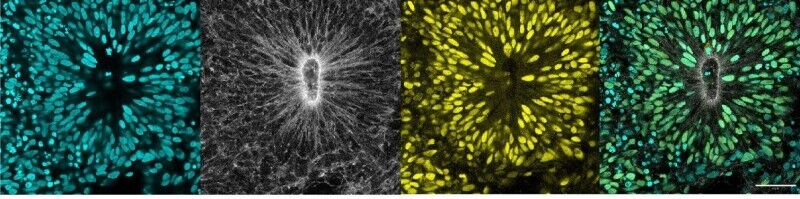
Human embryonic stem cell-derived neuroepithelial rosettes allow study of early neural development in a culture-dish: blue nuclei, white actin cytoskeleton, yellow neural progenitor marker SOX2, final image merge.
Research facility oversight/mentorship
- The Human Pluripotent Stem Cell Facility
- Dr Lindsay Davidson (Manager)
- Dr Margarita Kalamara (Research assistant)
Supervision
Graduate student co-supervision:
- Sophie Rappich, Wellcome (with Greg Findlay, MRC PPU)
- Namanpreet Kaur, (with Greg Findlay, MRC PPU)
Project development discussions:
- Art, Science & Visual Thinking module DJCAD/LS
Public understanding of science
Kate Storey and her group share their research with the public in a variety of ways, from school workplace experience and summer vacation studentships in the lab to School of Life Science and University open days for the public as well as contributions to science festivals. One way in which Kate Storey and members of her group reach a wider audience is through collaboration with artists Read more. This includes several collaborative Science-Art projects with her sister Helen Storey (University of the Arts London) and with Paul Harrison (DJCAD, University of Dundee).
Science art projects
- Primitive Streak - Kate & Helen Storey
- Woman’s hour Kate & Helen Storey talking about their collaboration
- Neurogenesis - Kate & Helen Storey working with Holition
- Designs for Life - project with Paul Harrison (DJCAD)
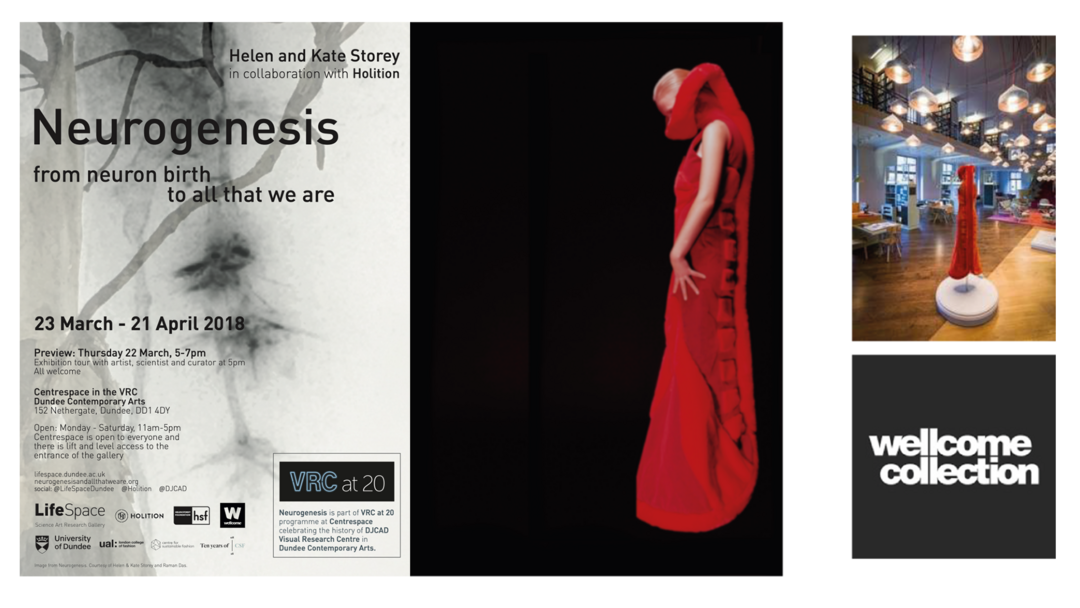
Poster from exhibition on Neurogenesis, the birth of new neurons – created by Kate and Helen Storey in collaboration with digital design company Holition. Red neurulation dress, designed by Helen and Kate Storey, part of the Primitive Streak collection, on public display at the Wellcome Collection reading room, London.
Select publications
Complete publication list ORCID 0000-0003-3506-1287
Dady, A., Davidson, L., Loyer, N., Rappich S, Findlay, G.M., Sanders, T., Januschke, J., Storey, K.G. (2025) Engineering fluorescent reporters in human pluripotent stem cells and strategies for live imaging human neurogenesis. Development. Nov 1;152(21): doi:10.1242/dev.205082. (cover image) PMID: 40748212
Rodrigo Albors, A., Singer G.A., May, A.P., Ponting, C.P. and Storey, K.G. (2023) An ependymal cell census identifies heterogeneous and ongoing cell maturation in the adult mouse spinal cord that changes dynamically on injury. Developmental Cell 2023 Feb 6;58(3):239-255.e10. doi: 10.1016/j.devcel.2023.01.003. PMID: 36706756
Semprich, C.I., Davidson, L., Amorim Torres, A., Patel H., Briscoe, J., Metzis, V., and Storey, K.G. (2022). ERK1/2 signalling dynamics promote neural differentiation by regulating chromatin accessibility and the polycomb repressive complex PLoS Biology Dec 1;20(12):e3000221.doi: 10.1371/journal.pbio.3000221. PMID: 36455041
Kasioulis I., Dady, A., James, J., Prescott, A., Halley, P.A., and Storey K.G. (2022) A lateral protrusion latticework connects neuroepithelial cells and is regulated during neurogenesis. J Cell Sci. 2022 Feb 25: jcs.259897. doi: 10.1242/jcs.259897. PMID: 35217862
Dady, A., Davidson, L., Halley, P.A, Storey, K.G. Human spinal cord differentiation proceeds rapidly in vitro and only initially maintains differentiation pace in a heterologous environment. eLife. 2022 Feb 21;11:e67283. doi: 10.7554/eLife.67283. PMID: 35188104
Poncet N., Halley P.A., Lipina C., Gierliński M., Dady A., Singer G.A., Febrer M., Shi Y.B., Yamaguchi T.P., Taylor P.M., Storey, K.G (2020) Wnt regulates amino acid transporter Slc7a5 and so constrains the integrated stress response in mouse embryos. EMBO Reports 21(1) doi/10.15252/embr.201948469 PMID: 31789450
Cañizares M.A, Albors A.R., Singer G., Suttie N., Gorkic M., Felts P., Storey K.G (2020) Multiple steps characterise ventricular layer attrition to form the ependymal cell lining of the adult mouse spinal cord central canal. Journal of Anatomy 236 (2), 334-350. doi/10.1111/joa.13094 PMID 31670387
Kasioulis I., Das, R.M., and Storey, K.G. (2017) Inter-dependent apical microtubule and actin dynamics orchestrate centrosome retention and neuronal delamination. eLife 2017;6:e26215. PMID: 29058679
Henrique, D, Abranches, E., Verrier, L. and Storey, K.G. (2015). Neuromesodermal progenitors and the making of the spinal cord. Development 42(17):2864-75 (Hypothesis article). PMID: 26329597
Das, R.M. and Storey, K.G. (2014) Apical abscission alters cell polarity and dismantles the primary cilium during neurogenesis. Science 343, 200-204. PMID: 24408437
Wilson, V., Olivera-Martinez, I., Storey, K.G (2009) Stem cells, signals and vertebrate body axis extension. Development, vol. 136, no. 10, pp. 1591-1604. doi.org/10.1242/dev.021246 PMID 19395637
Olivera-Martinez I.M., and Storey, K.G. (2007) Wnt signals provide a timing mechanism for the FGF/Retinoid differentiation switch in the extending body axis. Development 134, 2125-35. PMID: 17507413
Wilcock, A.C., Swedlow, J.R. and Storey, K.G. (2007) Mitotic spindle orientation distinguishes stem cell and terminal modes of neuron production in the early spinal cord. Development 134, 1943-54
Lunn J.S., Fishwick K.J., Halley P.A., Storey K.G. (2007) A spatial and temporal map of FGF/Erk1/2 activity and response repertoires in the early chick embryo Developmental Biology 302,536-52. PMID: 17123506
Delfino-Machín, M., Lunn, J.S., Breitkreuz, D.N., Akai, J. and Storey, K.G. (2005) Specification and maintenance of the spinal cord stem zone. Development 132, 4273-83PMID: 16141226
Diez del Corral, R., Olivera-Martinez, I., Goriely, A., Gale, E., Maden, M., and Storey, K (2003) Opposing FGF and Retinoid pathways control ventral neural patterning, neuronal differentiation and segmentation during body axis extension. Neuron 40, 65-79 PMID: 14527434
Brown, J.M., and Storey, K.G. (2000). A region of the vertebrate neural plate in which neighbouring cells can adopt neural or epidermal cell fates. Current Biology 10, 869-872 PMID: 10899008
Awards
| Award | Year |
|---|---|
| Fellow of the Royal Society | 2022 |
| National Sciences Prizes awarded since 1990 / British Society for Developmental Biology Waddington Medal | 2019 |
| Fellow of the Academy of Medical Sciences | 2017 |
| Member of the European Molecular Biology Organisation | 2016 |
| National Sciences Prizes awarded since 1990 / Royal Society Wolfson Research Merit Award | 2015 |
| National Sciences Prizes awarded since 1990 / MRC Suffrage Science Heirloom Award | 2014 |
| Major Personal Funding Awards / Wellcome Trust Senior Investigator Award | 2013 |
| Fellow of the Royal Society of Edinburgh | 2012 |
| Fellow of Learned Societies and Colleges / Fellow of the Royal Society of Arts | 2011 |
| Fellow of the Royal Society of Biology | 2011 |