
Screening projects at NPSC
Our team of Assay Development and Screening Scientists have all the expertise and experience required to develop, miniaturise, and then run and analyse, HCS assays on a range of cell-based models
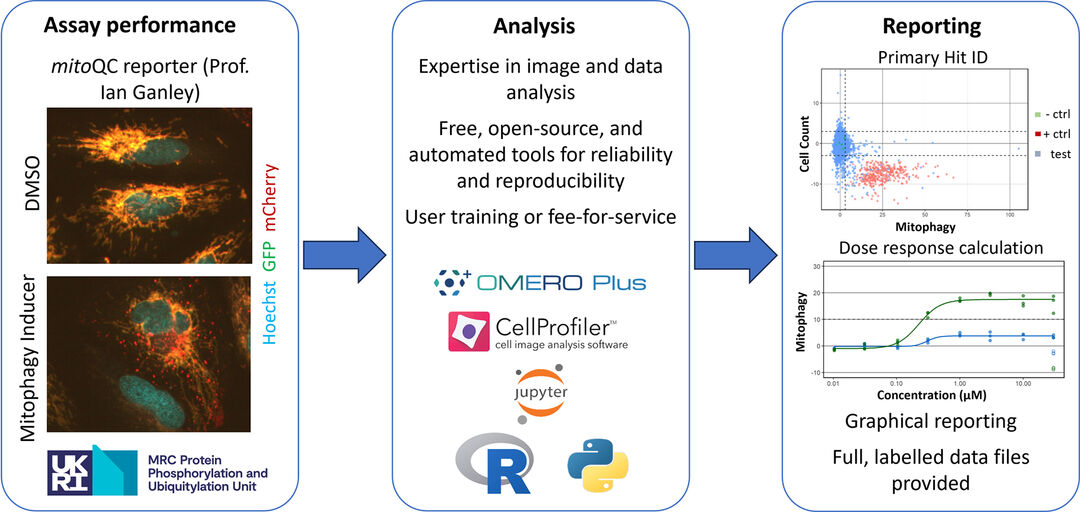
Assays are run on our end-to-end platform: from wet lab assay performance, to image and data analysis, and reporting. Our Assay Scientists are experienced cell biologists, image, and data analysts. Our expertise in automated tools facilitate rapid, reliable, and reproducible assay performance. We have a proven record of working with Academics from within the University of Dundee, other universities in the UK and EU and biotech and pharma companies around the world. Confidence in our data is of fundamental importance: Assay QC is included in our reporting so you can trust our data to inform key decisions.
Examples of assays we have run include:
- IF-based assays:
- Nuclear translocation assays: measurements of transcriptional regulators into nuclei
- Live cell assays: quantitative assays of cell dynamics in response to drug treatments
- Cell Painting: cell organelle labelling to reveal mechanism of action
- Pathway reporters: antibody and fluorescent protein-based reporters of expression for assessing effects of targeted degradation approaches
- Plate Reader-based assays:
- ELISA
- HiBiT
- Luminiscence and Fluorescence-based reporter assays (e.g. Cell Viability assays)
Tracking assays on primary sperm samples:

Sperm motility assay (tracking sperm cells)
Automated Robotic Platform for high throughput screening
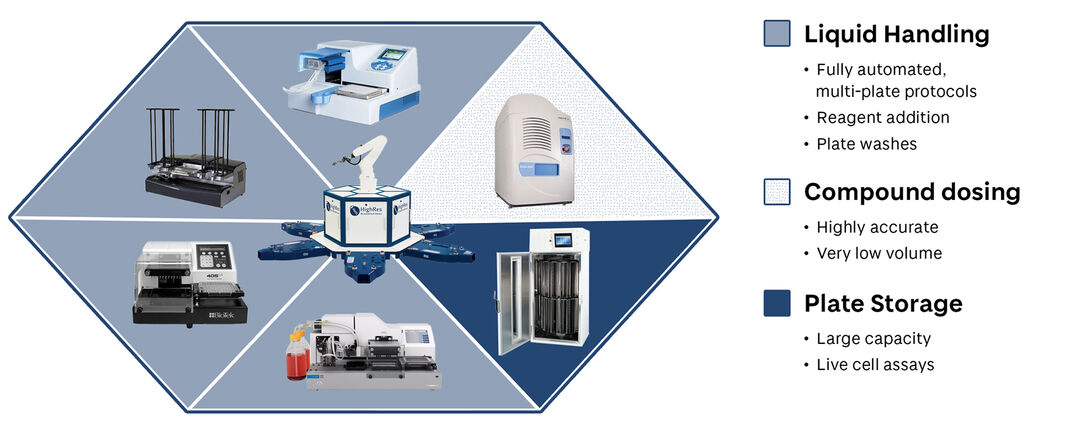
Our robotic automation platform (HighRes Biosolutions) is fitted with all the equipment required for the complete performance of high-throughput screening assays. Our Equipment page has further details.
Each screening plate includes multiple positive and negative control wells, allowing us to monitor assay performance using established statistical measures. Any plates that do not meet quality standards are reviewed and, where needed, excluded or repeated. Control data is also used to normalise results, ensuring consistency across plates and screening batches.
We also perform sub-plate quality checks to identify localised issues or spatial biases within a plate. Where appropriate, these effects can be corrected using established data-processing methods. All QC checks and corrections are integrated into our automated workflows, and we provide clear visualisations and summary data to give our customers confidence in assay performance.
Get in touch using our enquiry form, or e-mail [email protected] .
We can develop and screen assays for you. We use control treatments (high and low signal) to assess the assay for robustness and to assess assay performance throughout assay development and screening.