
News
£2.37M MRC Programme Grant Awarded to Prof. Liz Miller
Professor Liz Miller from the School of Life Sciences has been awarded funding from the Medical Research Council to study how cells regulate protein secretion. Secreted proteins perform diverse functions important for human health.
Published on 5 November 2025

Professor Liz Miller
One third of the human genome encodes proteins that are secreted from cells. Secreted proteins come in many different shapes and sizes, and they perform diverse functions important to human health.
The new programme grant from the Medical Research Council will provide five years of funding to the Miller lab, a member of the Division of Molecular, Cell and Developmental Biology, to study how cells regulate protein secretion to accommodate very large proteins like pro-collagen and lipoprotein particles. Along with collaborator, Giulia Zanetti (UCL/Birkbeck/Francis Crick Institute), Liz’s team will explore the molecular mechanisms that generate transport carriers of distinct sizes and shapes to ensure the efficient secretion of diverse secretory proteins.
By understanding the mechanisms of the first step in secretion, the team hope to develop new ways to selectively manipulate this pathway, thereby potentially impacting a spectrum of diseases such as tissue fibrosis and heart disease. Tissue fibrosis is caused by unregulated collagen secretion and currently has few treatments while hypercholesterolemia, associated with excess lipoprotein particle release to the bloodstream, drives heart disease.
Central to the success of this research programme are the world-class facilities available within the School of Life Sciences, in particular the Human Pluripotent Stem Cell Facility, and the Fingerprints Proteomics Facility.
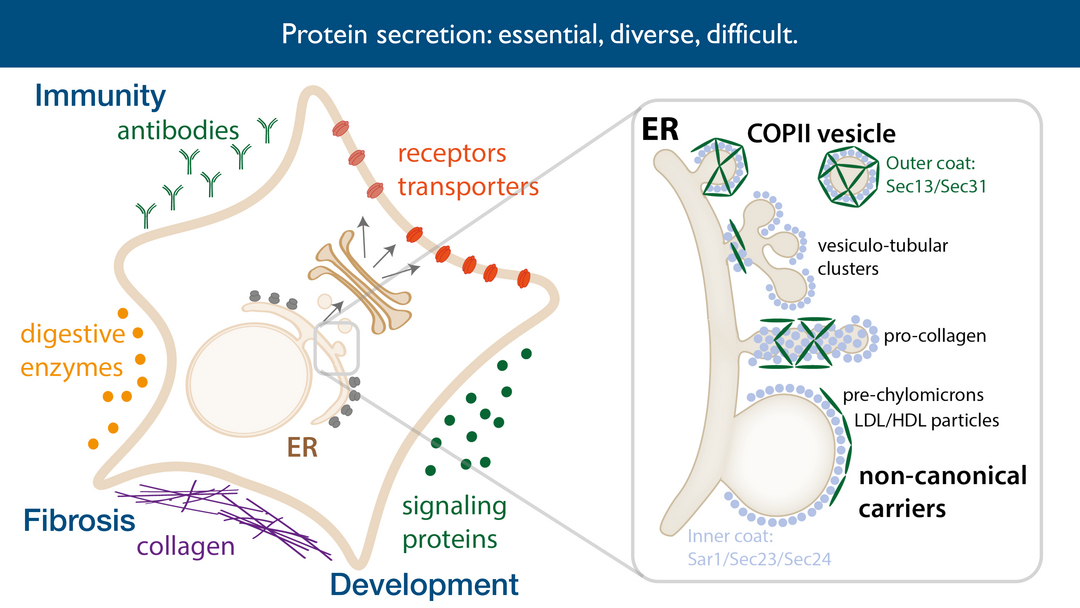
Schematic of protein secretion