
Procedure
Safeguarding Toolkit
The University's procedure for responding to safeguarding and welfare concerns, from receiving a report to closing a case
Updated on 19 September 2026
Purpose
The purpose of this toolkit is to help the University to implement the Safeguarding Policy and:
- Promote an environment in which all members of the University community can feel safe, respected and protected from harm and abuse regardless of race, gender, disability, religion, sexual orientation, age or social background
- Respond effectively and timeously to safeguarding and welfare concerns raised by or about a member of the University community
- Meet its legal requirements and sector expectations, as outlined in Appendix 1.
The Safeguarding Policy outlines:
- Key terms and definitions
- Principles
- Roles and responsibilities
- Scope.
The Safeguarding Policy relates to students and staff and is the University’s main framework for recording and responding to serious welfare concerns and incidents of gender-based violence, hate crime, including racism, Islamophobia, Antisemitism, and homophobia.
Section A: information for the whole university community
Information on when to raise a safeguarding or welfare concern, and who can raise one, is on the Safeguarding: how to raise a concern page.
Section B: how the university approach to safeguarding operates
(A) How a safeguarding or welfare concern will be responded to
Appendix 1 provides an outline of the response to safeguarding and serious welfare concerns.
Timescales
- Acknowledgement of receipt of a welfare concern report: half a working day
- Initial risk assessment, categorisation, triaging, assignment: one working day
- Assigned lead to reach out to reporting / reported parties: 1 ½ working days
- Case completion: 40 working days. This target is for a student’s or colleague’s immediate presenting situation to be stabilised and risk mitigated. On-going support from external services might still be required
Initial handling
Welfare concerns will be reviewed by the Student Welfare & Safeguarding team within the first working day following receipt using the tools detailed in the appendices to undertake the following four-step process:
- (1) Risk assessment: welfare concerns will be risk assessed to document the understood seriousness of the report, the urgency of response required and whether a student’s trusted contact should be involved (Appendix 2)
- (2) Categorisation: to document the type(s) of concern being reported, eg harassment, GBV, hate crime, safeguarding, etc, identify where additional expertise and support lies, and whether another university policy or procedure might apply
- (3) Triaging: identifying the route to follow to respond based on the risk to the reported concern. For some referrals, welfare concerns will be the main or sole concern; for others, professional standards, disciplinary procedures or other university procedures and guidance might take precedence. This can also potentially include referral to an external agency, typically social work or the police, eg if there are serious child protection concerns or suspicion that a serious crime has been committed
- (4) Assigning a lead: a lead will be assigned to follow up with the reporting and reported parties based on:
- The nature of the concern(s) identified
- The locus of the concern, eg student accommodation or a specific Faculty
- The relevant procedure deemed to apply.
Where the situation is relatively straightforward, the lead will be the member of the Student Welfare & Safeguarding team that first reviewed the report. For concerns regarding colleagues, the People team will be asked to provide the lead. For concerns within a specific Faculty or Directorate or where there are potential Fitness to Practice implications, the relevant area will be asked to assign a lead. Where a member of staff is the focus of the concern, the People team will be asked to lead.
Anonymous reports will also be reviewed as outlined above although typically it will not be possible to make an active response and typically the case will be closed.
Some people making raising a welfare concern might ask that the university takes no further action – their report is for information only. In those cases, typically the Student Welfare & Safeguarding team will review the report as outlined above, reach out to the person making the report to confirm their intentions and offer follow-up advice, and then close the case.
In emergency situations, the immediate response is likely to begin with a call to the police, potentially followed by social work, following liaison with the Assistant Director, wellbeing and Faculty Director of Operations.
Responsibilities of the assigned lead
The Student Welfare & Safeguarding team’s standard operating procedure outlines the limits on the team’s support for students, with the intention that they respond and contain a welfare concern to mitigate risk. On-going support cannot be provided in-house and signposting or referrals should be made to relevant external agencies where possible.
The assigned lead will be responsible for:
- Liaising with the member of the Student Welfare & Safeguarding team that risk assessed, categorised and triaged the original report
- Engaging further with the person who has made the report
- Discussing options with the complainant when the complaint alleges a criminal offence
- Identifying potential precautionary measures where a complainant is considering or making a report to the police
- Considering the welfare needs of all parties during any possible investigation and hearing
- Identifying and advising on potential progression routes under other university policies and procedures, including Dignity at Work & Study or staff/student disciplinary policies
- When the reported party also needs support, a new lead should be assigned to work separately with them.
Assessing individual capacity
There should always be a presumption of capacity. In line with the Adults with Incapacity (Scotland) Act (2000), a decision on incapacity should be based on whether the person can:
- Act in their own benefit
- Make decisions
- Communicate decisions
- Understand decisions
- Retain a memory of a decision.
In addition, any decision to intervene should lead to a benefit to the individual that could not be achieved otherwise.
Precautionary measures
Reasonable and proportionate precautionary measures should be considered if
- a student alleged to have committed a criminal offence or a serious breach of discipline, such as:
- Requiring the accused student not to contact the reporting student and/or certain witnesses and/or requiring the accused student to move accommodation
- Suspending the accused student from his/her studies
- Prohibiting the accused student from going to certain accommodation blocks or using the sports facilities or from attending a placement.
And
- Precautionary measures are necessary to:
- Ensure that a full and proper investigation can be carried out, either by the police or a university investigator and/or
- Protect the reporting student or others whilst the allegation is being dealt with as part of a criminal process or disciplinary process.
The use of precautionary measures is not a penalty or sanction and does not indicate that the university has concluded that the accused student has committed a serious breach of discipline or a criminal offence.
Progress monitoring
The assigned lead is expected to:
- Maintain notes of all significant actions taken and collate email
- Undertake a weekly review of the risk level to factor in new information
- Provide an update report to the weekly cause for concern review meeting and, where required in the most serious cases, attend. A report template is provided in Appendix 3
- Meet the 40-day closure target to mitigate risk, signpost or make referrals to external agencies where appropriate, and end direct contact with the student.
Oversight - weekly safeguarding review meetings, involving
Covering:
- Noting of progress to resolve current cases within the 40-day target where risk is rated as low or medium
- Discussion of current cases where risk is rated as high
- Make recommendations on progression routes under other university policies and procedures, including Dignity at Work & Study or staff/student disciplinary policies and refer to the appropriate Faculty or Directorate
- Discussion of cases unresolved after 40 working days
Representation:
- Student Welfare & Safeguarding team
- Campus Security
- People
- Assigned leads as required, including Disability Inclusion representation
Closure
- Situation resolved with no significant risk of continued or renewed welfare concerns
- Student’s studies suspended or concluded
Unless there is good reason not to, a confirmation of case closure will be sent to the original referrer.
A summary process map is provided in Appendix 1.
(B) Working with the individual
The following outline of the operation of the safeguarding toolkit is based on the University of Strathclyde guidance for responding to student disclosures of gender-based violence on campus.
Communication
- Speak with the student in a private area to retain confidentiality. Think sensitively about the choice of meeting place and consider trauma-informed good practice
- Listen to and acknowledge what the student is saying
- It is important the student feels believed
- Reassure the student:
- that the abuse is not their fault
- they have the right to feel safe
- help is available.
Assessment and safety planning
- The assigned lead should conduct and maintain a risk assessment and consider potential mitigations, including working on an individual safety plan with the student, referring to in-house support services, external support services or calling the police and/or social work
- The risk assessment should consider the reporting party but also others around them, such as under-16s in their home
Supporting individual agency
- Work with the student to identify what they are wanting right now and, if possible, what they might be wanting next. Help them to set the pace and direction of what happens in response to their report
- Be conscious that they might be experiencing a traumatic response to the incident they are reporting, and also relating that incident to earlier trauma in their life
Record-keeping and confidentiality
- It is important to build trust with the reporting party, who might want complete confidentiality. Reassure them that you will take notes to help inform any follow-up they might want but they will be shared no further than safeguarding colleagues except with their permission or to inform a report to the police or social work where a serious risk to safety has been identified
- A report of sexual violence made soon after the incident when the reporting party is distressed could be used as corroborating evidence in a trial so care should be taken to take as close to a verbatim note as possible
Progress a university response when a crime might have been committed
Where a report is made of an incident involving another member of the university community that could potentially be a criminal offence, the reporting party should be guided through the options open to them:
- Make a report to the police
- Access specialist support while considering whether to report to the police, such as an NHS SARC (sexual assault response co-ordination service)
- Make a report to the university and request that the institution responds under its internal procedures, such as a staff or student discipline procedure
- Take no further action.
It is important to make clear to a reporting party requesting a university process and potential outcomes would be more limited than a police response could be.
The university could consider making a police report without the reporting party’s permission if the is a serious risk of further offences being committed, balancing that decision against the risk of further harm to the reporting party.
Universities UK recommends that internal disciplinary action is paused during a criminal investigation, apart from taking precautionary measures. However, where the reported party is a member of staff, it might be considered appropriate to continue taking concurrent internal action.
Next steps & documentation
Notes of a meeting with a student who is making their first report of a crime, for instance sexual assault, can potentially be used in court as corroboration so care should be taken to record what the student has said without elaboration or interpretation.
Manage
Often, once the immediate safeguarding or serious welfare concern has been addressed, general concerns for the student’s welfare and academic progress will remain. In those situations, with the student’s agreement, the Advisor of Studies (or other significant academic point of contact) should be made aware of the situation and asked to remain in regular (eg monthly) contact, plus end of semester checks on grades.
Additional consideration should be given to students under the age of 18, partly because they can still be considered children for safeguarding purposes and because sourcing emergency accommodation is more practically difficult. Assigned leads for under-18s should consider escalating faster than they otherwise might so additional support can be put in place effectively.
Initiating welfare checks
When direct contact has been lost with a student and there is a significant concern for their welfare, the following steps can be taken:
- Step 1: the assigned lead should use available information to review of level of concern for the student. Attendance records can be checked on SEATs: if they are continuing to attend classes in line with their long-term average, concern levels can be revised down, for instance. It can be possible to monitor access for students staying in on-campus accommodation with swipe access. When the subject of a welfare concern is stays in a private (PBSA) hall, it might also be possible, with prior approval, to liaise with hall staff to undertake a welfare check
- Step 2: the assigned lead will give the student a clear deadline for making contact using a voice message to their personal phone number, email to their university address (with received and read options turned on) copied to their personal address. Make it clear that if they do not respond by the deadline, the plan will be to reach out to their trusted or emergency contact and/or the police
- Step 3: the assigned lead should seek permission in anticipation of a failure to respond from the Faculty Director of Operations and confirm with Student Records contact details for the student’s trusted and emergency contacts, plus their latest local address
- Step 4: if there is no response by the deadline, the assigned lead should reach out to:
- First: the student’s trusted contact; failing that:
- Second: their emergency contact; failing that:
- Third: the police to request a welfare check.
Moving from a safeguarding to a disciplinary response
Where a serious welfare or safeguarding concern arises through the actions of a student or member of staff, a key route to mitigating or ending risk will often be through the relevant university disciplinary procedure. In those situations, both alleged victim and alleged perpetrator should:
- Get clear, early information about what is alleged, what the process is, and what the realistic range of outcomes looks like
- Be told how the procedure operates and what they can expect, including support in meetings
- Expect welfare support throughout the process.
Risk assessment
The first step to be taken on receiving a welfare concern should be a risk assessment. Factors to be addressed risk assessing and triaging a welfare concern include:
- Risk of harm to the individual or to others
- Capacity of the individual to safeguarding their own interests
- External time constraints requiring a speed of response
- Lead and escalation points – including Senior Advisor of Studies; Assistant Director, Wellbeing; Faculty Director of Operations.
The risk assessment tool and triaging tool is provided in Appendix 2.
A specialist assessment might also be needed, for instance in complex cases where additional risks are identified.
Alleged conduct that might constitute a criminal offence
Sector guidance from Universities UK should be referred to when a safeguarding concern involves behaviour that might constitute a criminal offence.
Support should be offered to the alleged victim to make a police report if that is their intention in line with the university’s commitment as a Third-Party Reporting Centre.
If the alleged victim wishes to pursue a police report, the criminal process should take priority. A university investigation or disciplinary process should only begin once the criminal process has been concluded. Precautionary measures, for instance requiring the alleged perpetrator to avoid deliberate contact with the alleged victim, can be introduced while the criminal process is underway.
Governance and oversight
The Chief Operating Officer has responsibility for the university’s delivery of its general duty of care, response to welfare concerns and response to specific safeguarding concerns. It is important that the university can maintain an accurate overview of concerns being raised by students and colleagues to inform future responses and preventative action. In addition to detailed case notes, baseline indicators should also be collated, including:
- Category of concern
- Risk level assessed on receipt of concern and on closure of the case
- Student’s Faculty, level of study and key demographic information relating to relevant protected characteristics
- Venue for concern, including accommodation and online
- Procedure followed in response
- Outcome.
In addition, the members of the cause for concern group should review implementation of this procedure every 6 months and make recommendations for improvements to the Education & Student Experience Committee.
Embedding safeguarding
Safeguarding visitors: including school parties
- Risk assessments for organised visits should include consideration of safeguarding risks, including staffing ratios to ensure children are always accompanied and whether staff (including student ambassadors) should have PVG membership
- The University’s Safeguarding Procedure should routinely be provided in advance to external organisers hiring facilities or arranging visiting groups
Safeguarding in teaching, learning and assessment: including placements and in liaison with host organisations
- Academic and professional services staff arranging for students to visit other organisations as part of their studies, regardless of whether they are assessed, should request from the host institution a copy of their safeguarding procedure or equivalent (eg an HR procedure covering bullying and harassment)
- Students arranging their own work experience should be encouraged to request this as part of their preparations
Safeguarding away from the course: including routine pastoral support and additional support for residents in university accommodation
Safeguarding should be a mandatory element of annual training for student club and society committee members with a requirement for clubs and societies to ensure behaviour standards and reporting lines are published and shared with all members.
Safeguarding in research
Safeguarding should be an integral element of research approval processes to ensure protection of participants and offer an identified response to welfare concern.
Safeguarding and the wider community: including children of students and staff, visitors to university events
Safeguarding and risk mitigation should be considered as part of routine risk assessments for on-campus events involving visitors and guests.
Awareness raising & training
Student Services and Senior Advisors of Study share responsibility for raising awareness across the university community of the procedure and support available. For students, this should begin from induction and be reinforced through the academic year. This should be supported by training and campaigns around the student commitment to good conduct, ‘look after your mate’, general safety on and off campus, sexism, gender-based violence, racism, homophobia and transphobia.
Similar general training should be routinely available for advisors of studies, Student Wellbeing team staff, ResLife assistants, DUSA staff and sabbaticals.
There should also be specific training on implementation of this procedure for relevant colleagues in Student Welfare & Safeguarding, People and Faculties.
GDPR compliance
The university’s response to welfare concerns is covered by the Privacy Notice for Safeguarding.
Appendix 1
Summary safeguarding procedure map
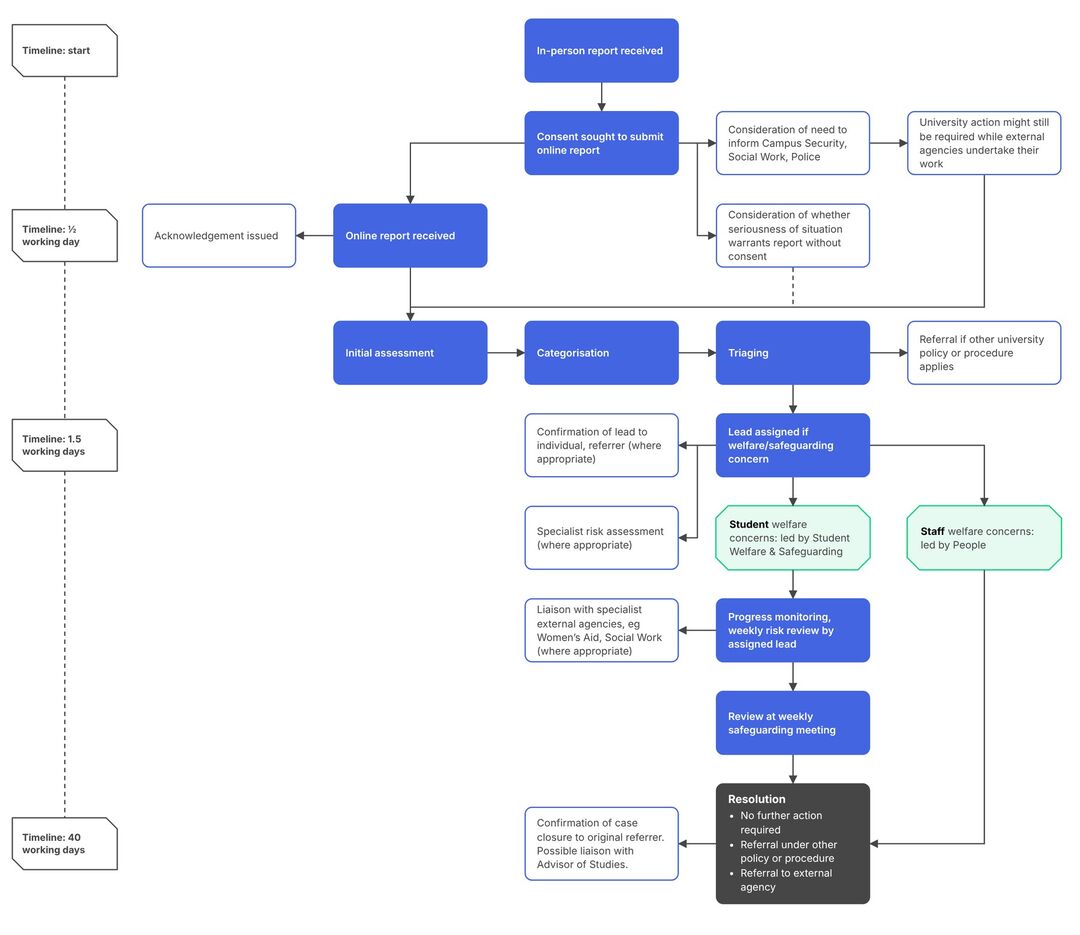
Timeline: start
- Any member of the university community receives a safeguarding or serious welfare concern report.
- Actions:
- Ask for the reporting person's consent and submit an online safeguarding report if they agree.
- Considerations:
- If the reporting person does not give consent, consider the seriousness of the allegations and the risk of harm to others and whether Campus Security, Social Work or the Police should be contacted regardless.
Timeline: 1/2 working day
- Initial response from the university safeguarding group to a report.
- Actions:
- Acknowledge receipt.
- Categorise – ie safeguarding, serious welfare concern, report for information only, disciplinary matter, etc.
- Triage to gauge the seriousness and urgency of the report.
- Refer to the appropriate alternative route if not a safeguarding/serious welfare concern.
Timeline: 1.5 working days
- Initial follow-up work begins.
- Actions:
- Lead assigned (People representative for staff matters).
- Risk assessment.
- Liaison with specialist external agencies, potentially including the Police, Social Work, Women's Aid.
- Progress monitoring at weekly safeguarding meetings.
Timeline: up to 40 working days (target)
- Resolution:
- Actions:
- No further action required.
- Referral under other policy, procedure.
- Referral to external agency.
- Confirmation of case closure to original referrer. Possible liaison with Advisor of Studies.
Appendix 2
Risk assessment
- Safeguarding and welfare concern referrals will be risk assessed against a 5-point scale using a standard tool detailed in the safeguarding policy, covering the referred person’s personal circumstances, their work or study setting, and the extent of their existing support arrangements
- Typical responses to each level risk are outlined below, with more detailed guidance provided in the Safeguarding Procedure. The Safeguarding Operational Group is expected to maintain a register of precedents as part of its routine reporting to support the University to develop good practice based on experience
| Risk rating | Typical scenario | Typical response | Typical lead / Escalation |
|---|---|---|---|
| Stage 0 Routine questions | Practical inquiry that raises no other issues. | Direct the student to the correct webpage, building, member of staff, etc. | None. |
| Stage 1 Recent concerns | Short-term issue or difficulty with minor impact on studies and/or personal life, eg sleeplessness affecting class attendance. | Offer of practical support, signposting to Advisor of Studies or specialist in-house support service(s). | Lead: Advisor of Studies. Escalation: Senior Advisor of Studies. |
| Stage 2 Routine concerns | Long-term issue or difficulty with minor impact on studies and/or personal life, eg financial concerns. | Referral to specialist in-house support service(s). | Lead: Senior Advisor of Studies. Escalation: Safeguarding Operational Group. |
| Stage 3 Intervention expected | Serious short-term issues impacting studies and/or personal life without immediate risk of harm to self or others, eg homelessness. Prevent concern. | Referral to specialist support services (in-house, external) with follow-up to ensure engaging meaningfully. Precautionary safety measures. Consideration of mitigating circumstances. Possible addition to cause for concern register and active monitoring. | Lead: Safeguarding Operational Group. Escalation: Senior Counsellor & Clinical Lead. |
| Stage 4 Urgent in-house intervention | Serious long-term issues impacting studies and/or personal life without immediate risk of harm to self or others, eg homelessness. | Referral to specialist support services (in-house, external) with follow-up to ensure engaging meaningfully. Precautionary safety measures. Consideration of recurring circumstances. Addition to cause for concern register and active monitoring. | Lead: Senior Counsellor & Clinical Lead. Escalation: Assistant Director, Wellbeing. |
| Stage 5 Emergency safeguarding intervention | Immediate risk of harm to self or others, eg suicidal intent. | Call GP, emergency services, social work, police (as appropriate). Call trusted/emergency contact. Specialist risk assessment. Addition to cause for concern register and active monitoring. Fitness to Study, Fitness to Practice consideration. | Lead: Assistant Director, Wellbeing. Escalation: Faculty Director of Operations. |
Appendix 3
Weekly case review template
To be completed by the lead advisor no later than noon the day before the scheduled cause for concern meeting for review by group members.
Standard weekly safeguarding meeting agenda
Cases to be discussed
| Individual(s) | Background | Lead | Category | Notes | |
|---|---|---|---|---|---|
| 1. | [A] reporting [B] | ||||
| 2. | |||||
| 3. | |||||
| 4. | |||||
| 5. | |||||
| 6. | |||||
| 7. | |||||
| 8. | |||||
| 9. |
AOCB
| Item | |
|---|---|
| 1. |
Appendix 4
Fife
Fife Adult Support and Protection