
Public engagement project
Inside Forensic Science Podcast: Series 5
In series 5 of the podcast we investigate a notable case in the late 19th Century

Active
July 2026
August 2026
Inside Forensic Science takes listeners on a journey through historic Scottish criminal cases while asking experts in forensic science, law and medicine today – what has changed and what might be done differently now?
Series 5 of the podcast delves into a notable case in the late 19th Century. When a series of three explosions shake the city of Glasgow one late night in January 1883, the resulting investigation will go on to shape the field of forensic science.
Trailer
Episodes
The Inside Forensic Science podcast is available to download via all major podcast providers.
Join us in our Facebook group to discuss the podcast.
The podcast was commissioned by the Leverhulme Research Centre for Forensic Science (LRCFS) at the University of Dundee and funded by the Leverhulme Trust.
Inside Forensic Science is an Adventurous Audio production. The series is written and narrated by Pennie Stuart, the story consultants and series researchers are Heather Doran (Public Engagement Manager, LRCFS) and Clara Morriss (Public Engagement Coordinator, LRCFS). The sound mix was by Steve Bull.
Experts:
- Professor Niamh Nic Daeid - Director of Leverhulme Research Centre for Forensic Science, University of Dundee
- Professor James Crossland - Professor of International History at Liverpool John Moores University
- Chris Hester MCSFC - Post-blast Investigator and Forensic Consultant
- Professor Aileen Fyfe FRSE - Professor of Modern History, University of St Andrews
- Lt Col Steve Johnson - military officer and forensic scientist, Head Defence Counter CBRN Capability Team
- Amy Bruce - PhD student, Leverhulme Research Centre for Forensic Science
- Mike - the Forensics Explosives Laboratory
Thank you to all of our voice actors: Zeb Soanes, Neil Wallace, Caroline MacPherson, Sam Young, Joe Reilly, Jake Lee, Chris Dolan, Mark Stephens, Stephen Hollywood, Kevin Colclough, Alan Richardson, Steve McRitchie, Andrew Thompson and Angus Hull.
Episode 1: The Gas Works
Content warning: This series discusses the use of explosives for terrorism. Episodes will contain sounds of explosions, statements from victims and descriptions of injuries as well as other content you may find disturbing. Viewer discretion is advised.
On the night of 20 January 1883, a series of explosions rang out in the city of Glasgow, Scotland. Was this an accident or an act of malice? The top minds of the 19th century raced to deduce the answer.
In this episode, we will follow the investigation of Colonel Vivien Majendie, the first Chief Inspector of Explosives in the UK, as he determines the cause of the explosion at Tradeston Gas Works.
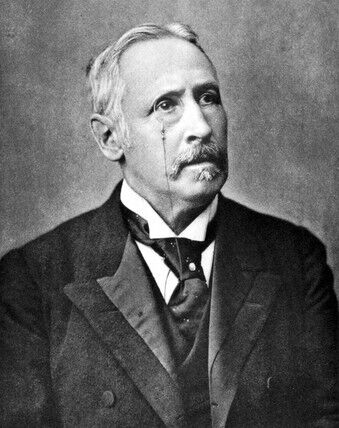
Black and white photograph of Colonel Vivian Dering Majendie, taken in 1895.
Image provided by WikiMedia.
Episode 2: By Design
Content warning: This series discusses the use of explosives for terrorism. Episodes will contain sounds of explosions, statements from victims and descriptions of injuries as well as other content you may find disturbing. Viewer discretion is advised.
It is 1883 in Glasgow, Scotland and Colonel Viviene Majendie has determined that the explosion at the Tradeston Gas Works on 20 January was no accident. What evidence led him to this conclusion and what could have triggered this explosion?
We ask for input from modern day forensic experts as we discuss this pivotal case in British Crime History.
Episode 3: Infernal Machines
Content warning: This series discusses the use of explosives for terrorism. Episodes will contain sounds of explosions, discussions of terrorism, statements from victims and descriptions of injuries as well as other content you may find disturbing. Viewer discretion is advised.
The explosion at Tradeston Gas Works on that night in Glasgow January 1883 was only one of many. Just two hours after the first explosion, a party of six spot a strange box in the middle of a bridge on Possil Road. Was this explosive box linked to the earlier explosion at the gas works? What can forensic science tell us about these events, the perpetrators behind them and their goals?
Extra Resources
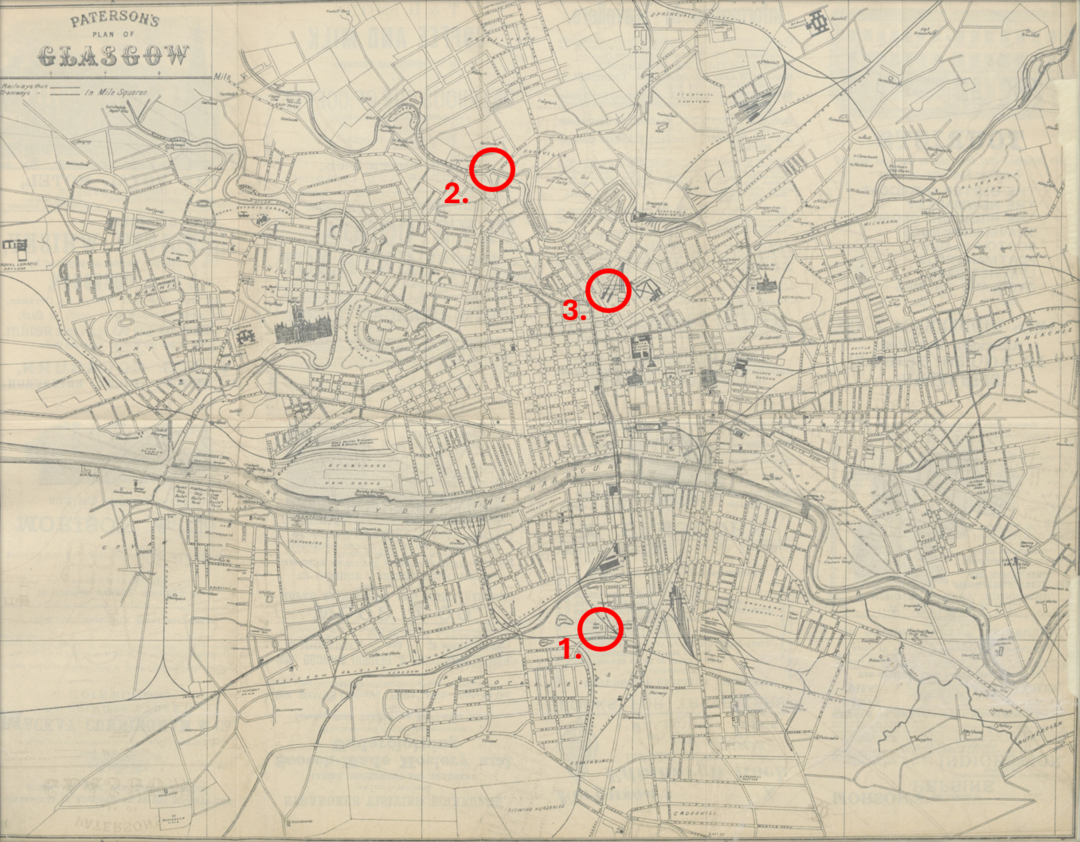
Digitised map of Glasgow in 1883 from page 9 of "Paterson's Guide to Glasgow, the Clyde, and Land of Burns".
The numbered circles show where the three explosions took place on the night of 20 January 1883.
- Tradeston Gas Works
- Possil Bridge
- Buchanan Street Railway Station
Original image sourced from the British Library on Flickr.
Episode 4: Bomb Makers
Content warning: This series discusses the use of explosives for terrorism. This episode contains sounds of explosions, discussions of terrorism including audio of calls to emergency services, statements from victims and descriptions of injuries as well as other content you may find disturbing. Viewer discretion is advised.
Three devices set up to explode within three hours of each other over one night in Glasgow 1883. Investigations have revealed that this was a deliberate act of terrorism. Now it’s up to investigators to discover who did this, how and why.
In episode 4 of the Dynamite Detectives we ask, who were the people who planned this attack and what was going on in the 19th century to incite these acts of terrorism?
Episode 5: The Ribbon Society
Content warnings: This series discusses the use of explosives for terrorism. Episode 5 contains sounds of explosions, discussions of terrorism, statements from victims and descriptions of injuries as well as other content you may find disturbing. Viewer discretion is advised.
As police investigate the 1883 Glasgow Explosions, a man approaches a local constable with some vital information about a group of men with the goal of emancipating Ireland from the UK at any cost…
In episode 5 of Inside Forensic Science series 5 we investigate the Ribbon Society, how they attempted to build a bomb in secret and how they were caught.
Episode 6: The Verdict
Content warnings: This series discusses the use of explosives for terrorism. Episode 6 contains sounds of explosions, discussions of terrorism, statements from victims and descriptions of injuries, as well as other content you may find disturbing. Viewer discretion is advised.
17th December 1883, ten men stand on trial in Edinburgh for the Glasgow explosions.
In the final episode of this series of Inside Forensic Science, we discuss the fates of the men known as the ‘Glasgow Dynamitards’ as well as the ways in which forensic explosives investigation has changed over the centuries. Hear from modern day experts as they discuss how the threat of terrorism has changed with advancing technology and how experts work to keep on top of this arms race.
Extra Resources
People
Leverhulme Research Centre for Forensic Science
[email protected]