
Public engagement project
Inside Forensic Science Podcast: Series 4
In series 4 of the podcast we investigate a case of stolen identity

Active
July 2025
In each series of the Inside Forensic Science podcast we examine historic cases from Scotland and ask experts in forensic science, law and medicine today – what has changed and what might be done differently now?
Series 4 explores a case of stolen identity. On Sunday 29th September 1935, two women on an afternoon walk just outside of the small town of Moffat make a grisly discovery: small, wrapped packages containing the dismembered body parts of two unknown people. This begins a several month-long investigation to uncover who the victims were and how they met their untimely fate.
In this series we show how forensic scientists work to reclaim the identities of victims and bring their stories to light.
Trailer
Episodes
The Inside Forensic Science podcast is available to download via all major podcast providers.
Join us in our Facebook group to discuss the podcast.
The podcast was commissioned by the Leverhulme Research Centre for Forensic Science (LRCFS) at the University of Dundee and funded by the Leverhulme Trust.
Inside Forensic Science is an Adventurous Audio production. The series is written and narrated by Pennie Stuart, the story consultants and series researchers are Heather Doran (Public Engagement Manager, LRCFS) and Clara Morriss (Public Engagement Coordinator, LRCFS). The sound mix was by Steve Bull.
Experts:
- Janet Tildesley, Volunteer Curator, Moffat Museum
- Professor Dame Sue Black, President of St John's College, University of Oxford
- Dr Lorna Dennison-Wilkins, Police Search Adviser, British Police Service
- Dr Martin Hall, Scientific Associate, Natural History Museum London
- Professor Caroline Wilkinson, Director of the Forensic Research Institute (FORRI), Liverpool John Moores University.
- Graham Strong, Forensic Operations Lead, Scottish Police Authority
- Jo Millington, Lead Blood Pattern Analysis (BPA) Scientist, SPATTER/ED
- Chris Gannicliffe, Forensic Lead - Biology, Scottish Police Authority
- Kenny Laing, Forensic Services, Scottish Police Authority
- Alex Prentice KC, Crown Office
- Professor Niamh Nic Daeid, Leverhulme Research Centre for Forensic Science, University of Dundee
Thank you to all of our voice actors: Alan Wall, Janna Millar, Sam Young, Neil Wallace, Mark Stephen, Jake Lee, Mary Hemsworth, Chris Young, Pam McIntosh, Alan Richardson, Dan Holland, Sam Young, Ali Ellam, Pam McIntosh, Andy Uttley, Heather Doran, James Hitchmough, Nick Small, Ali Cameron and Craig Swan.
Episode 1: The Ravine
Content warning: discussions of dead bodies, decomposition and dismemberment
On a quiet Sunday in September 1935, two women walking outside the small town of Moffat stop at a stone bridge overlooking a ravine through which a small waterfall and stream flowed. It was then the women spotted something shocking, a partially decomposed human arm protruding from a small package. Police found many similar packages strewn across the ravine, each containing human body parts. Thus began a long investigation into the identities of these unknown people.
In this episode, we discuss how police in 1935 investigated the scene at the ravine. How were they certain these body parts were human? How did their investigation compare to forensic practises today?
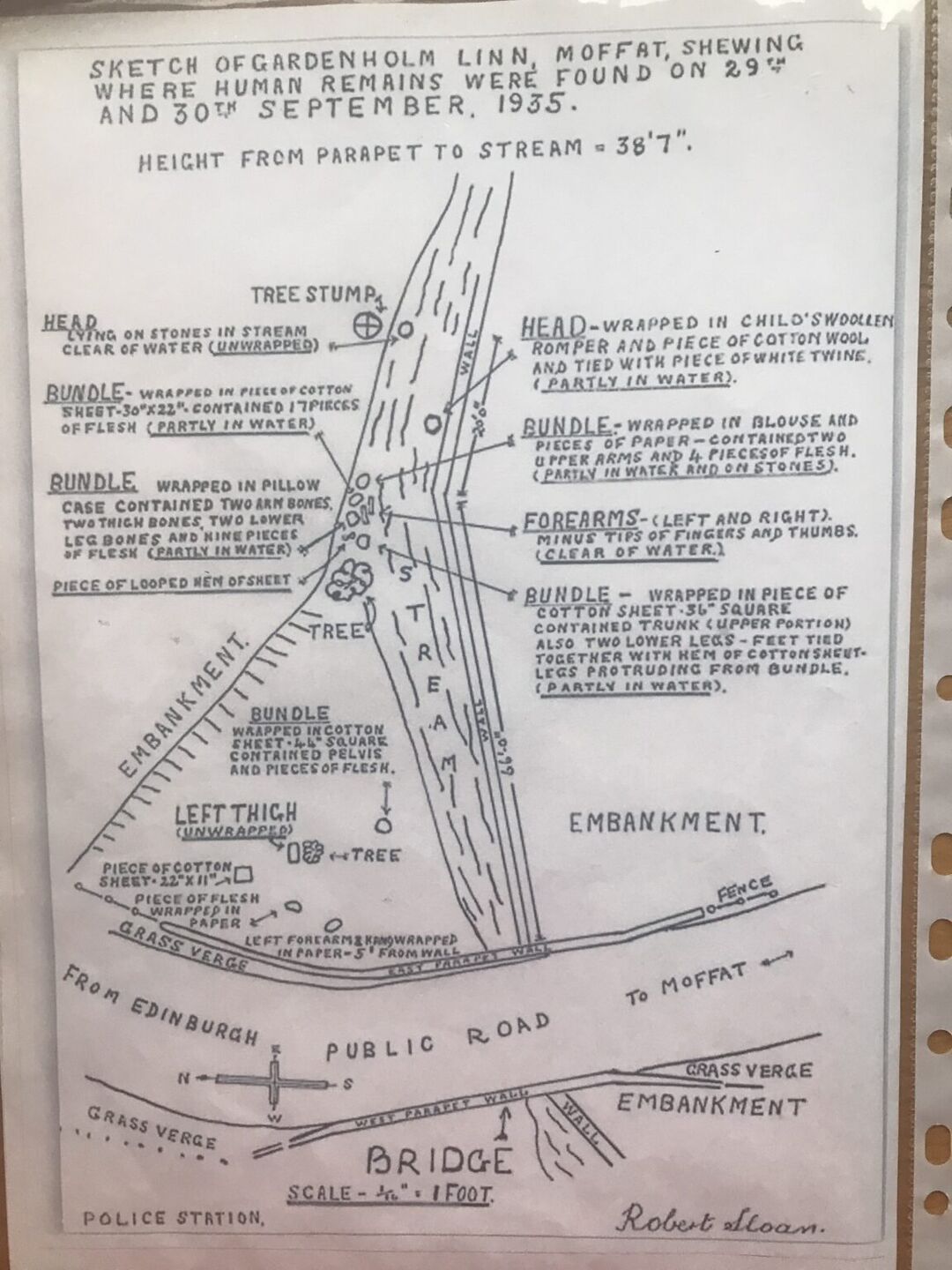
Sketch of the Moffat site made by Sergeant Robert Sloan during the original investigation in 1935. The location of each recovered parcel can be seen.
Image provided by the Moffat Museum.
Evidence recovered from Gardenholme Linn in 1935
Episode 2: Sin Eaters
Now the body parts have been recovered it is now the responsibility of forensic scientists to attempt the gruelling task of examining and putting the pieces back together. However, with DNA unavailable as a forensic technique in 1935, what other forms of examination could experts use to identify a body?
In this episode we discuss what story a body can tell us about a person’s sex, age or lifestyle as well as some of the innovative new experiments that were carried out to identify to bodies from Moffat.
Episode 3: The Maid and her Mistress
Content warning: discussions of dead bodies, decomposition and dismemberment
Investigators initially thought the two bodies from Moffat were of a man and woman.
However, further investigation leads police to suspect that they may be mistaken. Not long before the bodies were found a young maid from Lancaster and her mistress were reported missing. Could the bodies found in Moffat belong to these two missing women?
In episode 3 we discuss how it was possible for investigators to link these two missing women in the case.
Superimposition of the Skulls
Episode 4: But is it Mary?
Content warnings: mentions of domestic violence and discussions of dead bodies, decomposition and dismemberment.
How can investigators be sure that the bodies found in Moffat were those of Mary Jane Rogerson and Isabella Ruxton? Who did this to them and why?
In episode 4 we discuss more of the forensic science techniques that were used to identify the victims of the Moffat murders.
Episode 5: Written in Blood
Content warning: mentions of domestic violence and discussions of dead bodies, decomposition and dismemberment.
Having arrested a suspect for the murders, investigators shift their attention to the potential crime scene in 2 Dalton Square, Lancashire. What did forensic scientists find and what does it tell us about what happened to Mary and Isabella?
In episode 5 we discuss what evidence was found at the Ruxton home and what it can tell us about what happened to the two women.
Episode 6: The Trial
Now all the evidence is gathered, it becomes the role of prosecutors and expert witnesses to prove their evidence in the court room.
As we delve into the final episode of this series, we explore what went on in the court room and what became of the culprit.
Extra Resources
Trial papers from the trial of Buck Ruxton
The Moffat Ravine murders have also been covered in an exhibit by the Moffat Museum.
We are grateful for their assistance in acquiring resources for this season of Inside Forensic Science.
People
Leverhulme Research Centre for Forensic Science
[email protected]