
Areas to visit at the Botanic Garden

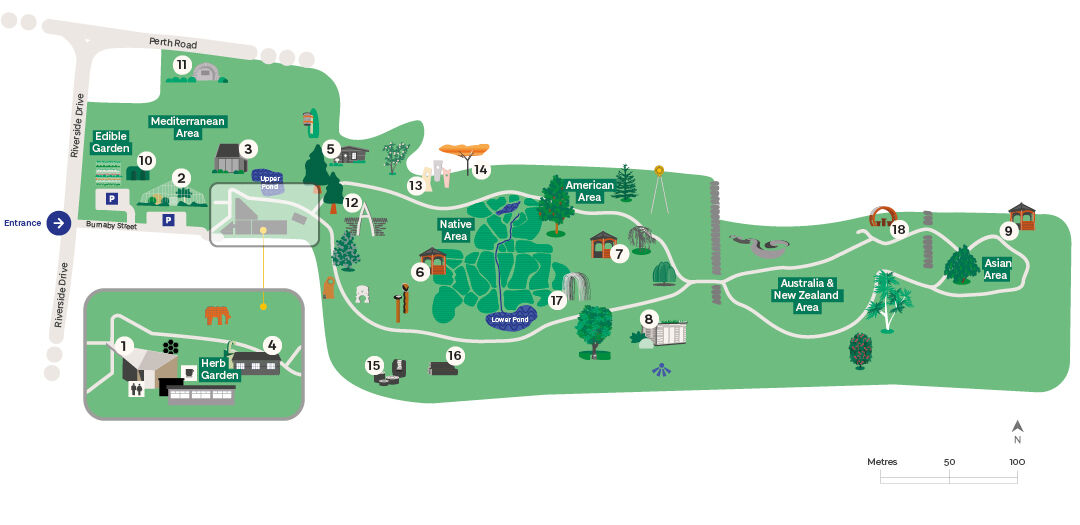
Botanic Garden map
-
Visitor Centre
Containing the office, reception and small shop.
-
Glasshouses (Desert and tropical plants)
One of our glasshouses demonstrates plant life in the tropical rainforest, where citrus fruit can be frequently found, coffee beans grow and the pond contains giant water lilies. The other glasshouse takes you on a journey through a temperate region with bananas and insectivorous plants, to an arid zone with cacti and other succulents.
-
Living Lab
The living lab is a physical place where we both host and undertake research on the living collections in the garden and university grounds. The building is also known as the Macromicro Studio and was created as a prototype zero-energy, self-sufficient laboratory by staff and students in the University.
-
Paterson Centre
Education Centre named after Dr Neil Paterson, the Botanic Garden’s Education Officer for over 20 years who passed away in 2021. It is a wooden log style cabin building used for various events and functions.
-
Small hut
-
Eddie Kemp Pavilion
A traditionally styled pavilion named after the garden's first curator.
-
Ingram Gazebo
Find a secluded spot in the garden and relax
-
The Green Gallery and Tay View
The Green Room Gallery shows exhibitions of work by established and aspiring artists who celebrate the wonder of the natural world. Outside the gallery is a viewpoint over the River Tay with views to Fife.
-
Pagoda Pavillion
-
Yew/Kissing Hedge
-
Bandalusian Well
Built in 1979/1980 and marks where our natural water source enters the Garden.
-
Garden of Evolution
The Evolutionary Garden represents the evolution of plants from the primitive lichens and mosses to flowering plants. It includes impressive dry-stone walling. The Genetics Garden is also housed in this area.
-
Good Grief Garden
A dedicated memorial garden for visitors to reflect on a lost relative or friend. Designed by Dundee alumna Lorena Weepers, at the heart of the garden are four specially commissioned obelisks, representing the seasons of the year.
-
SiMBA Tree of Tranquillity
Hand-crafted, life-sized sculptures, made from steel, where each leaf (made from copper) on the tree represents a baby who has died. NHS Tayside worked alongside SiMBA and Tayside Sands to bring this tree to life in Dundee.
-
Storytelling Area
-
Sensory Garden
-
Willow Tunnel
Created in 2017 for children to play in. Funded by the Friends of the University of Dundee Botanic Garden.
-
Playground
Areas to explore
Herb garden and Mediterranean plants
The shelter provided by the glasshouses in the Mediterranean Area creates a temperate microclimate ideal for these plants.
Mediterranean area
The Mediterranean collection, to the north of the glasshouses, includes a wide range of plants whose natural habit is dry soil.
Native Area
The native plant area depicts the vegetation founds in Scotland from high mountain top to seaside. As you can walk alongside the mountain stream, and through the glen, you see the change from low-growing plants at the top to scrubby plants lower down. This leads into birch pine wood, and oak woodlands, onto the nutrient-rich loch.
American Area (North and South American plants)
The American area of the garden includes a developing Eastern North American collection. This takes the visitor from the Fraser Fir (Abies fraseri) forests to mixed deciduous woodlands.
Australia and New Zealand area (Australasian plants)
In the Australasian section of the garden there is a large collection of Eucalyptus from Australia and Tasmania.
Asian area
The last area of the garden holds the Asian collection, with many plants from China and the Himalayas.