

Contact
Websites
Biography
Virginia De Cesare was born in Rome, Italy. She graduated cum laude in Biotechnologies from the University of Rome "La Sapienza" before undertaking an industry-based PhD at Novartis Vaccines (now GSK Vaccines) in Siena, Italy, where she developed strong expertise in mass spectrometry (MS).
In 2015, Virginia moved to Dundee to join the MRC Protein Phosphorylation and Ubiquitylation Unit (MRC-PPU). She initially worked in the Mass Spectrometry group where she developed novel MALDI-TOF/MS–based strategies to investigate the ubiquitin pathway. She later joined the research groups of Satpal Virdee and Paul Davies, where she contributed to a range of academic and industry-collaborative projects exploring ubiquitin biology and enzyme mechanisms.
In 2021, Virginia established her own research group at the MRC-PPU, where her team develops mass spectrometry–based approaches to investigate non-canonical ubiquitylation and uncover new mechanisms of ubiquitin signalling.
Research
Investigating the hidden code of ubiquitin and how it controls human health and disease
Cells use a tiny protein called ubiquitin as a molecular tag to control what happens to other proteins. Disruption of ubiquitin pathways is linked to a wide range of human diseases, including neurodegeneration and cancer, and understanding these mechanisms opens new opportunities for therapeutic targeting.
For many years scientists believed that ubiquitin was attached only to one specific building block of proteins called lysine (canonical ubiquitylation, see fig. 1). We now know that ubiquitin can also be attached in unexpected ways to other amino acid, such as serine and threonine, but also sugars and nucleic acids (non-canonical ubiquitylation, see figure 1) revealing a hidden layer of cellular regulation that our research aims to uncover.
Non-canonical ubiquitylation represents a largely unexplored regulatory system with the potential to reshape our understanding of cell biology. By defining how non-canonical ubiquitylation works, De Cesare lab aims to build a more complete picture of ubiquitin biology and to establish new technological frameworks that can be applied across biology and biomedical research.
Using an interdisciplinary approach that combines quantitative proteomics, genomics, molecular biology, protein biochemistry and cell-based functional assays, our work investigates how ubiquitin is attached to alternative amino acids and biomolecules, and how these modifications influence protein behaviour and human health and disease.
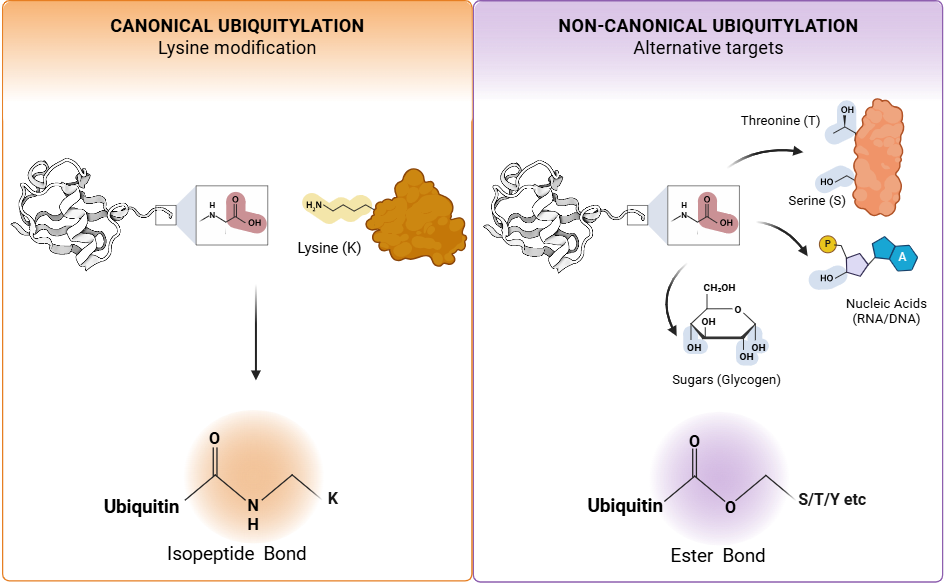
Figure 1. Canonical versus non-canonical ubiquitylation. Left panel: Ubiquitin is covalently attached to lysine residues via isopeptide bond formation. Right panel: Ubiquitin can also be conjugated to alternative substrates, including Serine and Threonine residues and other biomolecules, via distinct chemistries, expanding the scope of ubiquitin signalling.
Selected Publications
1. Abdul Rehman, S.A., et al., Discovery and characterization of noncanonical E2-conjugating enzymes. Sci Adv, 2024. 10(13): p. eadh0123.
2. De Cesare, V., et al., Deubiquitinating enzyme amino acid profiling reveals a class of ubiquitin esterases. Proc Natl Acad Sci U S A, 2021. 118(4).
3. De Cesare, V., et al., High-throughput matrix-assisted laser desorption/ionization time-of-flight (MALDI-TOF) mass spectrometry-based deubiquitylating enzyme assay for drug discovery. Nat Protoc, 2020. 15(12): p. 4034-4057.
People in my lab
- Chiara Cazzaniga (Post-Doctoral Research Associate)
- Gabrielle Taylor (Research Technician)
- Hope Obasi (PhD Student)
- Valerio Perticaroli (Visiting PhD Student)
Other Research Activity
The De Cesare lab is actively developing MALDI-TOF/MS and LC–MS–based technologies with a strong focus on translation and commercialisation. This includes the expansion of established platforms such as the deubiquitylating enzyme (DUB) profiling service and KIPIK, enabling high-throughput, quantitative analysis of enzyme activity for both academic and industry partners. These efforts aim to bridge fundamental discovery with applied research by delivering robust, scalable mass spectrometry–based solutions for target validation, inhibitor screening, and mechanism-of-action studies.
Teaching
- BS32037 Cell Signalling – contributor (Lecture Mass Spectrometry in Cell Signalling)
- Honours Year – project supervisor
- Integrated MSci – project supervisor
PhD Projects
Principal supervisor
- Type
- PhD opportunity
Exploring Non-Canonical Ubiquitination and Its Biological Roles
Awards
| Award | Year |
|---|---|
| Personal Fellowships / UKRI Future Leaders Fellowship | 2021 |
Stories
- Type
- News
Virginia De Cesare awarded UKRI Future Leaders Fellowship and MRC-PPU PI position
Virginia De Cesare has been awarded a UKRI Future Leaders Fellowship, one of the UK’s flagship fellowship schemes for early career investigators, in addition to being promoted to an Independent Investigator position within the MRC-PPU.
- Type
- Feature
COVID Stories: Dundee scientific expertise refocussed to the pandemic response (Part 1)
In 2020 the research landscape across the world has shifted focus to work together to combat COVID-19. In the School of Life Sciences, many of our staff and students, a group that continues to grow, have joined this collective research effort.