
Dr Claudia Martinho
Lecturer

Contact
Biography
Claudia Martinho is a plant geneticist and epigeneticist whose work focuses on how plants store and transmit information about their environment across generations. She trained in plant molecular biology and stress responses during her PhD and postdoctoral research in Portugal and the UK, including at the University of Cambridge, and in Germany at the Max Planck Institute.
She is currently a Lecturer (Assistant Professor) in Plant Genetics and Epigenetics at the University of Dundee, where she leads the Crop Epigenetics Group and studies climate-induced memory and non-Mendelian inheritance in crop systems.
Research
Plants are exposed to changing environmental conditions throughout their lives, including heat, drought, and other climate-related stresses. Unlike animals, plants cannot move away from these challenges, but they can adjust how their genes are used in ways that help them cope. In some cases, these responses can be remembered over time or even passed on to future generations. My research investigates how plants store, maintain, and transmit this “memory” of past environments, and how understanding these mechanisms could contribute to developing more resilient crops.
Research description
My research focuses on mechanisms of climate-induced memory and inheritance in plants, including epigenetic and non-Mendelian processes such as paramutation. I am interested in how environmental information is encoded at the molecular level, how it is maintained across cell divisions or generations, and how it influences gene regulation and plant performance.
My group combines molecular genetics, epigenomics, and functional genomics approaches to study these questions in multiple crop systems, including tomato and strawberry. A central aim of our work is to bridge fundamental understanding of inheritance with long-term applications in crop resilience and sustainable agriculture.
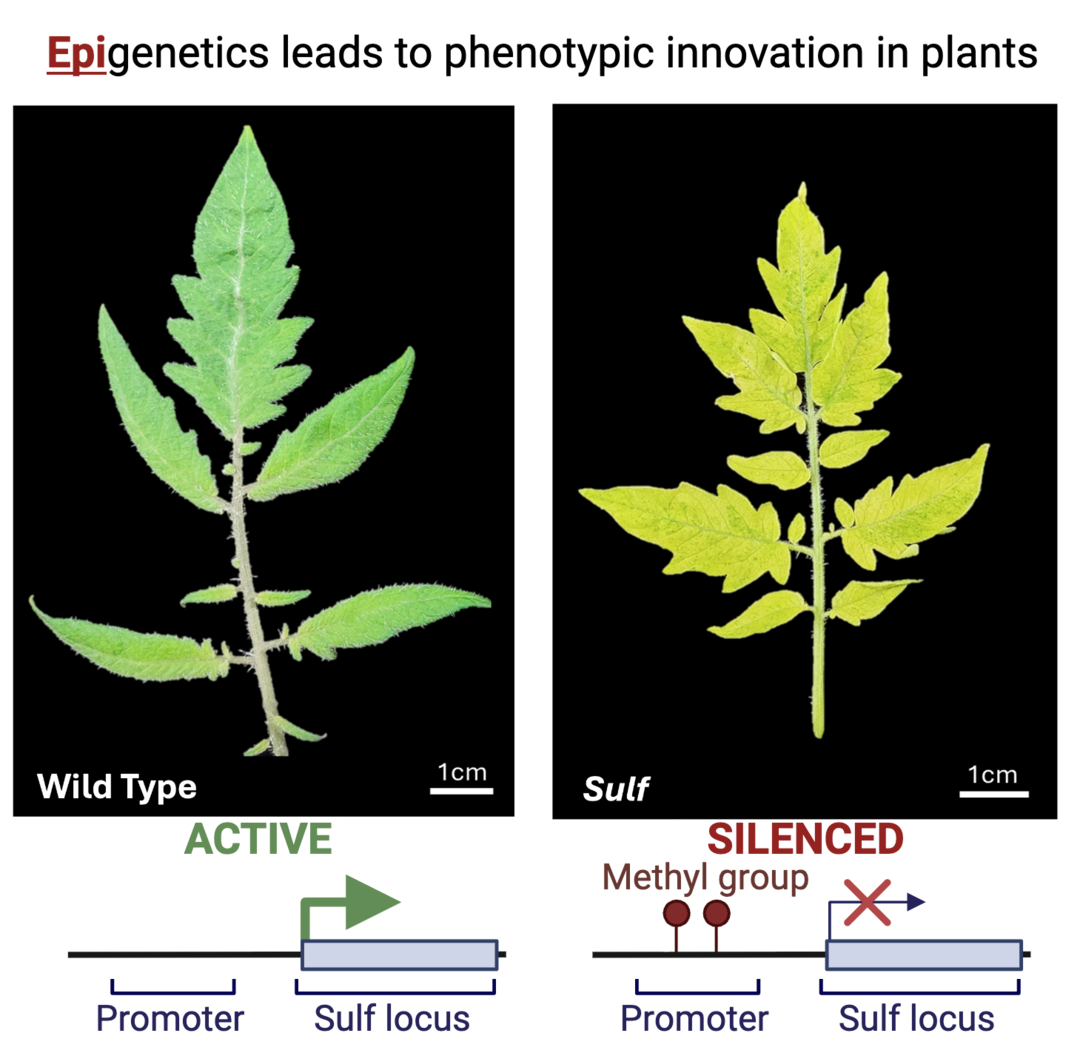
In plants epigenetics plays a crucial role in gene regulation and phenotypic variation
Selected Publications
- Martinho C. et al. (2022) CHROMOMETHYLTRANSFERASE3/KRYPTONITE maintains the sulfurea paramutation in Solanum lycopersicum. Proceedings of the National Academy of Sciences 119, e2112240119. DOI: 10.1073/pnas.2112240119
- Defines a chromatin-based mechanism maintaining paramutation and non-Mendelian inheritance in a crop species.
- Bukhanets V. et al. (2026) Germline fate determination by a single ARGONAUTE protein in Ectocarpus. Proceedings of the National Academy of Sciences. DOI: 10.1073/pnas.2518712123
- Demonstrates that a single Argonaute protein can control developmental transitions and germline specification in a multicellular alga. pnas.2518712123_review
- Martinho C. et al. (2025) Efficient CRISPR–Cas genome editing in brown algae. Cell Reports Methods. DOI: 10.1016/j.crmeth.2025.101273
- Establishes scalable genome-editing tools enabling functional genetics in brown algae.
- Luthringer R. et al. (2024) Repeated co-option of HMG-box genes for sex determination in brown algae and animals. Science 383, eadk5466. DOI: 10.1126/science.adk5466
- Reveals convergent evolution of sex-determination mechanisms across distantly related eukaryotes.
- Liu P. et al. (2024) 3D chromatin maps of a brown alga reveal U/V sex chromosome spatial organization. Nature Communications 15, 9590. DOI: 10.1038/s41467-024-9590-0
- Shows how higher-order chromatin organisation underpins sex chromosome regulation.
- Vigneau J. et al. (2024) Interactions between U and V sex chromosomes during the life cycle of Ectocarpus. Development 151, dev202677. DOI: 10.1242/dev.202677
- Dissects dynamic chromosome interactions across developmental stages in a UV sex-chromosome system.
- Martinho C. (2024) From RdDM to plant defence. Nature Plants 10, 1442–1443. DOI: 10.1038/s41477-024-01724-4
- Perspective linking RNA-directed DNA methylation to adaptive plant defence responses.
- Speth C. et al. (2018) Arabidopsis RNA processing factor SERRATE regulates the transcription of intronless genes. eLife 7, e37078. DOI: 10.7554/eLife.37078
- Shows that RNA-processing factors can directly regulate transcriptional output.
- Dickinson P.J. et al. (2018) Chloroplast signaling gates thermotolerance in Arabidopsis. Cell Reports 22, 1657–1665. DOI: 10.1016/j.celrep.2018.01.044
- Identifies organelle-to-nucleus signaling as a key regulator of heat-stress tolerance.
- Martinho C. et al. (2015) Dissection of miRNA pathways using Arabidopsis mesophyll protoplasts. Molecular Plant 8, 261–275. DOI: 10.1016/j.molp.2014.11.002
- Introduces a versatile experimental system to study small-RNA regulatory pathways.
Teaching
Claudia contributes to undergraduate and postgraduate teaching in plant and molecular biology, with a strong emphasis on laboratory-based and apprenticeship-style training. She is particularly interested in helping students develop practical competence, confidence, and experimental reasoning in the laboratory. Her teaching activities include:
- Academic lead for practical teaching: BS12010 – Core Skills in the Life Sciences (Level 1) – Practicals 1 and 2 (PCR and Genetics)
- Module leadership: Core Skills in the Life Sciences (Level 2) – practical-based training in molecular biology and experimental skills
- Undergraduate teaching contributions: Lectures and practical teaching on Building and Organism (Level 1) and Advanced Plant Sciences (Level 4)
- Postgraduate and honours training: Supervision and training of Honours, MSc, and PhD students in plant genetics, epigenetics, and functional genomics.
She is actively involved in teaching innovation, including the development of flipped-classroom materials and structured laboratory training resources to support student learning and consistency in practical work.
Public Engagement and Outreach
Claudia is actively involved in public engagement activities aimed at communicating plant science and genetics to broad audiences. She regularly contributes to large-scale public-facing events and science festivals, including Plant Power (2024, 2025) and Over the Garden Wall (2025), engaging with members of the public on topics ranging from plant biology to climate resilience and epigenetics. She also participates in education-focused discussions on the future of plant biology teaching and training, and regularly presents her research at national and international scientific meetings through invited talks and conference presentations.
Academic Service and Community Building
Claudia is a co-lead of the UK Plant Epigenetics Network (UK-PEN), supporting community building, training, and collaboration across the UK plant epigenetics community. Through this role, she contributes to organising workshops, meetings, and networking activities that bring together researchers across career stages and disciplines.
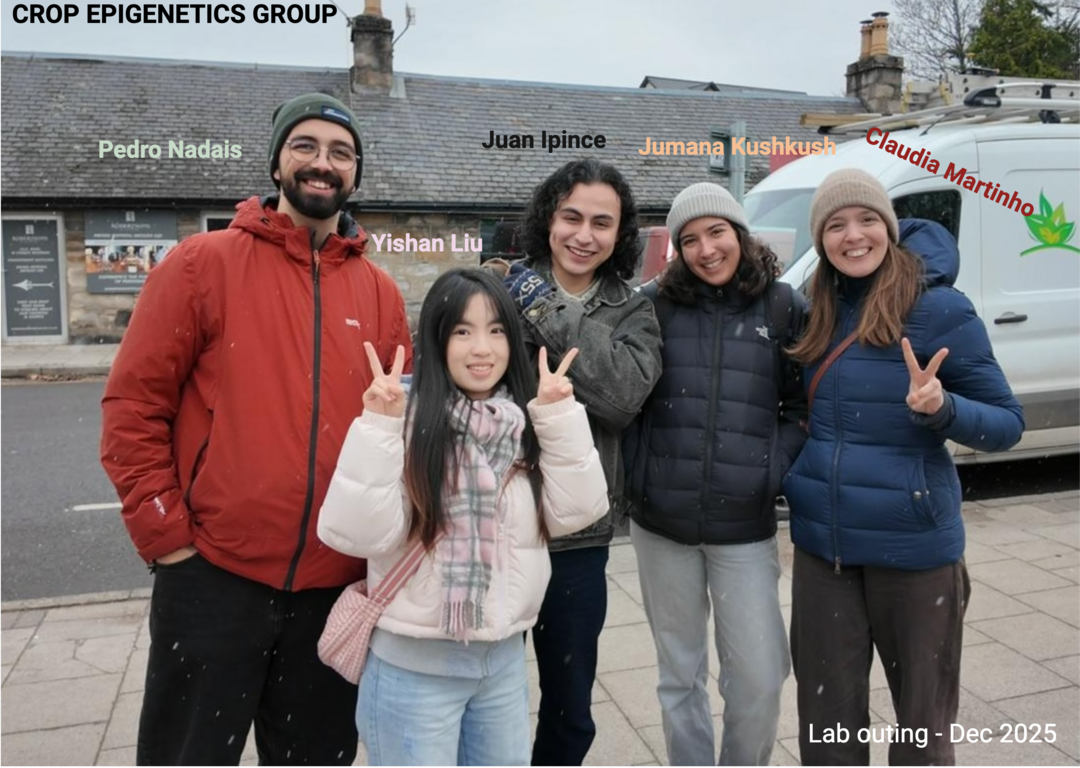
Lab outing in December 2025
Current members
- Pedro Nadais – PhD student (EASTBIO)
- Yishan Liu – PhD student (Chinese Scholarship Council, CSC)
Previous and visiting members
- Juan Ipince – Honours student
- Jumana Kushkush – Visiting researcher / collaborator
Awards
| Award | Year |
|---|---|
| Personal Fellowships / Leverhulme Trust Research Leadership Award | 2026 |
Stories
- Type
- Press release
New project to safeguard peat moss against changing climate
University of Dundee expertise is to contribute to a £2.7 million project to accelerate climate adaptation in Sphagnum moss – supporting peatland carbon storage, biodiversity and water retention.
- Type
- Press release
Strawberry fields forever? Scientists to study how crops remember environmental stress
University of Dundee experts will harvest knowledge from some of our favourite fruits to learn more about how plants remember and respond to extreme heat.