
Factsheet
Curriculum Design Principles
Our Curriculum Design Principles (CDPs) underpin all our programme development
Updated on 25 July 2025
Introduction to CDPs
- The purpose of establishing Curriculum Design Principles (CDPs) is to establish a core set of values and design elements that underpin all programme development and review at the University of Dundee, thereby providing a useful set of resources for those undertaking these tasks.
- The development of the CDPs was centred around a consultation document authored by the Vice- Principal (Education). This was discussed at four design sprints that included a broad stakeholder group of students, academic staff and professional services staff from across the university. This encouraged debate concerning the merits and deficiencies of the CDP document and the stakeholder feedback informed the final re-write. The resulting CDPs are l flexible, student-centred, sensitive to the requirements of individual subject specialisms, aligned to subject benchmarks, meet the accreditation requirements of Professional, Statutory and Regulatory Bodies (PSRBs), and consider modes of study, e.g. campus-based, distance learning, blended, partnership articulation arrangements, clinical.
- As the University develops new programmes and re-evaluates programmes undergoing Periodic Programme Review, the CDPs and the emerging curriculum development tools will provide a guide and a set of resources that will inform the design process and ensure that all Dundee programmes meet the highest standards
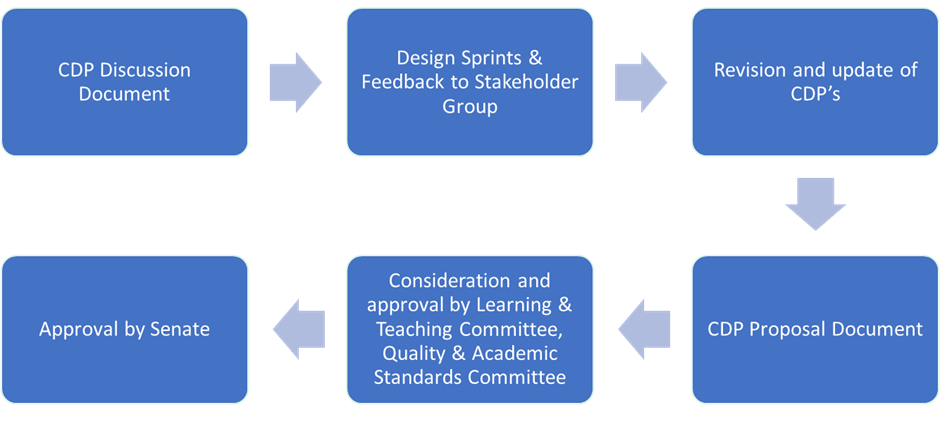
The process was as follows:
- CPD discussion document
- Design sprints and feedback to the stakeholder group
- Revision and update CPDs
- CPD proposal document
- Consideration and approval by Learning and Teaching Committee, Quality and Academic Standards Committee
- Approval by Senate
Programme planning
- Programme development at UoD should be informed by research excellence, aligned to the Hallmarks & Graduate Attributes, and be underpinned by sound business principles, resulting in the development of a suite of undergraduate, taught postgraduate, research masters (MRes), executive, and professional doctorate programmes, that are best in sector and attractive to students nationally and internationally.
- The portfolio of programmes offered by UoD should meet actual student demand, notably international student demand, given that UG domestic demand is managed via Scottish Government-funded places. Our ambition for the unregulated income growth should be to match the levels of student participation seen at other comparable institutions.
- There should be a balance of risk within the University’s portfolio of programmes in, 1) established markets where there is existing student demand and the University has previously failed to attract students (and grow unregulated income), and 2) innovative programme development in new, emerging or untested markets.
- As a general rule, ~80% of the School portfolio should consist of programmes where there is clear and demonstrable applicant demand. Students tend to be conservative in their choice of programme and well recognised degree titles are important for recruitment. This approach to risk provides schools with sufficient flexibility to explore novel and emerging markets, whilst retaining a focus on established markets.
- Market research must be undertaken to support new programme ideas before they are submitted to the Programme Approval Group. The marketing team will support such requests, but in addition, we have developed a self-service tool, the Market Intelligence Data Analysis System (MIDAS), that searches HESA data sets. This provides historical information on the numbers of students studying programmes in the UK which can filter students by keyword, institution, study level, nationality, study mode etc.
- The development of new programmes now requires PAG approval and the initial approval process will consider overall fit to the School or University portfolio, high value collaborative partnerships, and opportunities for module sharing (within and beyond schools).
- All new programme proposals, and existing programmes undergoing Periodic Programme Review, should undertake a sustainability evaluation that will examine, national and international market demand, the potential for fee income generation, competitor activity through benchmarking, and establish programme fit within the School. This type of programme evaluation should inform which will be developed, retained or retired from the School/University portfolio.
Hallmarks and Graduate Attributes
- All programmes at the University of Dundee should incorporate a set of agreed Hallmarks and Graduate Attributes that define our education offer. The hallmarks describe the immutable features of a University of Dundee education and apply to all programmes. Graduate Attributes describe the skills, attitudes, values and competencies that each student should have the opportunity to develop through their UoD experience (both academic and extra curricular), equipping them for success in their careers and wider society.
Hallmarks
- The UoD is a beacon of excellence within Dundee, Scotland and the UK, providing it with a global reputation for high-quality education, first-class research, and impact. Our research informs the development of our degree programmes, providing students with a distinct learning experience. In addition, we are a civic university that draws from, and gives benefit to, the city.
- Research-informed education: The hallmarks of a UoD education should be rooted in its hard-earned reputation for research excellence. All UoD degree programmes should draw on these research foundations and evidence-led enquiry to inform programme design thereby ensuring that teaching & learning is world-class.
- Civic-focus: UoD is an anchor institution in the City providing education and training to students, many of whom enter the local workforce. Our programme portfolio should, where possible, align to the needs of the city/region and provide high-quality & skilled graduates to local employers.
- Academic enquiry and stretch: UoD degree programmes should encourage students to acquire knowledge, develop critical and evidence-based approach to academic study, and interrogate accepted norms. UoD programmes must offer academic stretch to allow students to challenge themselves and reach their full potential.
- Active/experiential learning: All programmes must include elements of active/ experiential learning in which students participate in practical, interactive or problem-solving activities. The assessment of UoD programmes should be designed to test knowledge, skills and problem-solving ability as they apply to both academic and real-world situations.
- Focussed & authentic assessment: Assessment will evaluate student knowledge & understanding and should align to programme learning outcomes first and module learning outcomes second. As students progress through a programme, assessment should develop a range of research, analytical and communication skills that are relevant to real world situations and employment
- Inclusive curriculum: UoD degree programmes should be relevant and accessible to students from all cultures and backgrounds by design. The curriculum design should foster the development of learning communities, consider the intended audiences and be designed to meet the needs of all students. We aspire to be a global institution and our students can expect a globally relevant curriculum.
- Environmental Sustainability: All UoD programmes should now embrace environmental issues and consider how they inform the context for learning within a global world. Understanding how activity at a local level can impact global systems can nurture our students as agents of change.
Graduate Attributes
- Graduate Attributes define the broad qualities that University of Dundee graduates are expected to develop through their education. They are not limited to subject-specific expertise, but instead reflect a graduate’s ability to apply core knowledge with insight, creativity, and purpose. As graduates move into further study or the world of work, these attributes guide their approach to solving real-world challenges and contributing positively to society.
The University of Dundee has a core set of Graduate Attributes.
University of Dundee Graduates are:
Self-aware and agile
- Resilient, adaptable and flexible
- Reflective and committed to life-long learning
Digitally confident and subject specialists
- Subject specialists with a breadth and depth of knowledge
- Digitally fluent, leveraging strong research and data analysis skills
Ethically and socially responsible
- Embraces equality, diversity, and values a variety of perspectives
- Environmentally aware and focussed on sustainable solutions
Innovative and collaborative
- Entrepreneurial and critical thinkers
- Influential collaborators, working effectively in teams and demonstrating leadership in driving shared goals.
Professional and purposeful
- Professional and proactive in their approach
- Professional communicators using appropriate formats in different contexts
When developing a new programme or refining existing provision, in any discipline, programme teams should consider how the curriculum design can help develop these attributes. Some graduate attributes will be more relevant to certain programmes and others less so, but the programme documentation must demonstrate which attributes are developed as the student progresses through their chosen study path.
Programme development and curriculum design
High-Level programme design principles
- All programmes should have a clear educational vision that is informed by the excellent research environment and aligned to the Hallmarks & Graduate Attributes of a UoD Programme, and best practice in each discipline. This will enable developers to identify unique features for new programmes that allows them to stand out from competition, i.e. developing a clear proposition and USP.
- Academic Champion: All programme development should be led by an academic champion who is typically a subject expert and will lead the programme development team through the CDP process. Academic champions will ensure that full academic consultation is undertaken, and that programme development processes, and quality assurance processes are followed.
- External stakeholders, e.g. PSRBs, employers, industrial partners and third sector organisations, will be engaged to assist with programme development where required.
- Students: Our students will be partners in the programme design process and will work alongside academic champions so that their input is heard and acted upon.
- Accreditation: Alignment of professional programmes to Professional, Statutory and Regulatory Bodies (PSRBs) requirements must be a primary consideration to safeguard regulatory approval and accreditation.
- Sector mapping & best practice: The programme development team will make itself aware of best practice in each discipline through sectoral comparison, use of subject benchmark statements and PSRB guidance (where available) and this will inform programme design.
- Pedagogical approach: Digital Champions and programme teams should determine the underpinning pedagogical approach to be used and ensure that it is followed.
- Clear Learning Outcomes: Programmes should be designed around a set of clear learning outcomes, draw from research knowledge in each discipline, align to the CDP hallmarks and allow students to develop and demonstrate the agreed graduate attributes (see 1 above). Module learning outcomes and any related assessments should align to programme learning outcomes.
- Teaching methods: The methods for delivering the curriculum and its assessment should be viable, engaging and inspiring, thereby enabling students to achieve learning outcomes in the most effective way possible. Teaching methods should be accessible to students from all backgrounds and cultures.
- Academic champions and their programme development teams are encouraged to explore a diverse range of teaching methods and learning resources that will make each UoD engaging and unique. The Covid-19 pandemic stimulated many innovations in blended learning and has enhanced the University’s digital capabilities, and this learning should be drawn upon in all future programme development.
- Mode of delivery: The Programme Team should consider the primary mode of delivery at the outset, i.e. campus-based, distance learning/online or blended. We should increasingly encourage multi-mode delivery for core programmes where there is demonstrable demand. Lessons learned from the Covid-19 pandemic in terms of staff upskilling, increased used of digital platforms, digital tools, blended learning, hybrid delivery and e-assessment, should be incorporated into discussions about future programme design.
- Programme/pathway identity: Each programme should be distinct and where pathways are offered, they should align with both the ‘parent programme’, and have unique features, i.e. module combinations. It is important for each programme/pathway to demonstrate a clear identity to ensure that different degree awards cannot be achieved by choosing the same module combinations.
- Programme coherence: Programmes should comprise a coherent set of core modules and/or options that collectively address programme level learning outcomes and be able to demonstrate the development of knowledge and skills, as students progress through the programme.
- Employability: All students should have the opportunity to undertake personal development opportunities (employment readiness), engage with employers, experience entrepreneurship, undertake internship/work/ business-related activity & participate in study abroad activities as part of their programme (credit and non-credit bearing).Related to this, UoD should develop a credit-bearing internship shell module that is available to all students (mostly non-professional courses) that can be customised to meet the needs of different disciplines. The rationale for assigning credit to employment-related activities is to encourage participation, although these activities will be voluntary in nature, and no student will be disadvantaged as a result of non-participation.
- The development of employability-related resources will be led by the Careers & Employability Service who will advise on ideas for embedding employability skills within and around the curriculum.
- Study checkpoints: Essential study checkpoints, e.g. attainment of threshold concepts, work/placement experience, should be mapped within the programme structure.
Design principles
- Once the high-level programme design is complete, detailed curriculum design will be undertaken to ensure that the hallmarks are embedded in individual modules and that opportunities exist from students to develop the agreed graduate attributes.
- Subject benchmarking & QA: All programmes should be aligned to national subject benchmarks (Scottish Credit & Qualifications Framework Descriptors for levels 7-11), Subject Benchmark Statements (QAA) and align with the UK Quality Code for Higher Education (QAA).
- Curriculum content/syllabus will be designed by the programme team and discipline experts and will align with the high-level programme design principles. Student representatives should be included in the development of the curriculum content and syllabus. The international nature of the institution and its curricula should be evident in the content.
- Research-informed curriculum: A research-informed Apex Project/Dissertation/Final Year Project should be part of all programmes, and programme teams must ensure, and be able to demonstrate, that research -informed and evidence-based teaching is embedded throughout the entire curriculum
- Design for inclusivity: All new UoD curricula should be inclusive by design, relevant to students from different cultures and backgrounds, foster learning communities and develop understanding in a global world. Teaching and assessment styles should be relevant to students from different backgrounds, case studies & examples should be broad-based, and must be supported by appropriate learning resources. The Periodic Programme Review process will require existing programmes to review the inclusivity criteria available in the learning resources and modify programmes to ensure that they conform.
- Teaching methods: Teaching approaches should be clearly identified, and be diverse in order to make the programme interesting and to stimulate student engagement, e.g. active/experiential learning, problem solving activity, analytical skills, academic discussion and debate, lecture, design activities, meet the expert, development of practical/ laboratory/clinical skills and knowledge etc?
- Blended learning: Programme teams should consider to what extent a high-quality blended learning approach can be incorporated into modules, e.g. to support self-directed learning. This might be achieved through lecture capture, podcasts, online tutorials and online assessment. Such flexibility may be useful, particularly for students with caring responsibilities, or who need to work alongside their studies.
- Digital skills: All programmes should map digital skills across the curriculum to ensure that students have ample opportunity to develop and apply these skills. Consider how digital skills will be developed as learners progress through their programme.
- Transferable skills: Where possible transferable skills, e.g. writing, communication, problem solving, should be embedded within modules so that they can be developed in an applied manner/environment.
Programme structure
- Core & optional modules: The programme team will determine the balance of core and level of module optionality to provide students with a transparent, coherent and flexible programme structure that is easy to follow. Throughout the curriculum journey, acquisition of knowledge, development of understanding, and the acquisition of skills, should be clearly mapped and linked to the relevant SCQF levels and subject benchmark statements.
- Student choice: Where optional modules are offered, the level of choice should be sufficient to satisfy student interest and preferences but managed so that each module is viable and organisational efficiency is achieved. A minimum module enrolment of ~15 FTE at Undergraduate or TPG levels is suggested, although discretion will be given to Schools to justify any departure from normal practice at the programme approval stage.
- Excessive or confusing module choice should be avoided since this can impact programme coherence, result in large numbers of modules with poor enrolment, and increase organisational inefficiency and timetable/assessment issues. Teams should consider ways of presenting module choice that groups related or compatible modules to improve programme coherence (Appendix 1).
- Teaching efficiency must be considered, where academically justified, by limiting the number of low credit value modules. If cognate modules can be combined/merged, this provides opportunity for team-based teaching, reduces siloed learning, encourages a synoptic approach to learning, and opportunities for synoptic assessment. Moreover, it reduces risk associated with staff absence and increases organisational resilience. Smaller specialist modules may be more appropriate in honours years where specialist teaching is more common
Assessment and feedback
- We must ensure that all programmes are aligned to the Quality Code which suggests incorporation of a systematic, relevant and stimulating assessment strategy, that enables programme and module learning outcomes to be met, and to the University Assessment Policy. A set of assessment and feedback resources is available for staff to guide them through the design of programme and module level assessment, e.g. TESTA. Further resources will be added by sharing examples of good practice from newly developed programme documentation.
- What is the purpose of assessment?
- to determine whether students understand curriculum content and have achieved programme and module learning outcomes.
- to allow students to develop key skills essential for their development
- to allow students to engage, monitor personal progress, reflect, and enhance understanding.
- How should we assess learning outcomes? Assessment of core modules/options should align to programme learning outcomes first and module learning outcomes second. This ensures that assessment is coordinated across the programme and between modules. This is most easily achieved where programmes have a coherent structure and curriculum journey (see section 3.3)
- How do we ensure that assessment workload is fair for students? Programme leads should ensure that the student workload for each module is appropriate and that there is parity with other modules of equivalent credit value.
The number of independent study hours required to complete the assessments for a module of a set credit value should operate within a defined range. This ensures that different module combinations do not result in excessive or reduced student workload. - Assessment and the development of skills? Assessment comes in many forms and programme developers are encouraged to think about how assessment strategies can develop a student’s transferable skills as they progress through their course by revisiting modes of assessment.
- Assessment planning/congestion: Each programme should develop an assessment matrix that shows the formative and summative assessment tasks and schedules these so that student workload is effectively managed.
- There are three benefits to organising assessment in this way; 1) reduction of assessment congestion, 2) it helps students to manage their workload, and 3) effective management of staff marking workloads.
To assist with the development of an assessment strategy, the Transforming the Experience of Students through Assessment (TESTA) process is included as a mandatory component of new programme development and Periodic Programme Review, and guides programme developers through an audit of formative/summative assessment and feedback. -
Feedback: Programmes and modules must declare how feedback will be provided for different assessment elements within a module, include clear marking rubrics for each type of activity, and publish these on My Dundee. Feedback should be planned, scheduled, and be clearly identified as a feedback activity so that it is obvious to students how and when feedback is being provided.
Feedback should be provided in different forms, e.g. individual detailed written feedback on written work, oral feedback and discussion with advisers of study, generic class feedback on overall performance, provision of worked examples (good and bad).
Feedback training is provided to staff, but in general, any feedback must be clear, concise and avoid vague or general statements that are difficult to interpret. It should identify both strengths and weaknesses within a student’s work so that they know which areas to focus on in future.
Students must be provided with training so that they understand the purpose of feedback, the range of feedback provided, how to respond to feedback and how to improve future work based on feedback. Examples of feedback methodologies and resources are available to staff to review online to assist with the development of feedback strategies for programmes and modules.
References
- Scottish Credit and Qualifications Framework (2020)
- Scottish Credit and Qualifications Framework Descriptors (2012)
- The UK Quality Code for Higher Education (2018)
- University of Dundee: Assessment policy for taught provision
- Fenton J & Smith M (2019) You Can’t Say That!’: Critical Thinking, Identity Politics, and the Social Work Academy
- Academic Skills Centre TESTA Resources
Other Universities
Examples of curriculum design processes operating or under development at other universities.
- Curriculum Principles, University of Bath
- Curriculum 2021, University of Liverpool
- Principles for the development of the taught curriculum, University of Durham
- Curriculum design - the essentials, University of Sheffield
- Inclusive Curriculum Framework, Kingston University, London
- Dilly Fung: A Connected Curriculum for Higher Education
- Advance HE: Inclusive Curriculum
- Related to Gradaute Attributes - IB learner profile which helpfully explains each attribute
- University of Edinburgh: Student-Led, Individually-Created Courses (SLICCs)
Appendix 1A
Some examples of programme structure:
Programme Structures and National Student Survey (NSS) Rankings
BSc Biological Sciences
- Total Modules: 29
- NSS Ranking: 2nd in Scotland / 20th in the UK
- Structure by Year:
- Year 1: 20 core credits, 20 optional credits
- Year 2: Core – 20, 10, 10, 20, 20, 20 credits; Optional – 20 credits
- Year 3: Core – 15, 15, 15, 15 credits; Optional – 15, 15, 15, 15 credits
- Year 4: Core – 40-credit project, 20 credits; Optional – 15, 15, 15, 15 credits
MA Humanities
- Total Modules: 21
- NSS Ranking: 4th in Scotland / 16th in the UK
- Structure by Year:
- Year 1: Core – 20, 20, 20, 20, 20, 10, 10 credits
- Year 2: Core – 20, 20, 20, 20, 20, 20, 20 credits
- Year 3: Mix of core/optional – 30, 30, 30, 30 credits
- Year 4: 30, 30, 30, 30 credits (presumably all core)
BA Fine Art
- Total Modules: 15
- NSS Ranking: 1st in Scotland / 21st in the UK
- Structure by Year:
- Year 1: Core – 20, 20, 20, 20, 40 credits
- Year 2: Core – 40, 20, 40, 20 credits
- Year 3: Core – 30, 30, 30 credits; Optional – 30 credits
- Year 4: Core – 30 credits; Optional – 90 credits
BSc Computer Science
- Total Modules: 23
- NSS Ranking: 5th in Scotland / 28th in the UK
- Structure by Year:
- Year 1: Core – 20, 20, 20, 20, 20 credits; Optional – 20 credits
- Year 2: Core – 20, 20, 20, 20, 20, 20 credits
- Year 3: Core – 20, 20, 20, 20, 20, 20 credits
- Year 4: Core – 60, 15, 15 credits; Optional – 15, 15 credits
Appendix 1B
MSc Jute, Jam & Journalism
- Total Credits: 180
- Programme Design: The MSc offers multiple flexible study paths, with varying combinations of core, optional, and capstone modules. There are three main structural formats, outlined below:
Structure Option 1: "2 out of 8" Combination
- Semester One:
- Core Modules: 20 + 20 credits
- Optional Modules: Choose 2 out of 8 modules (each worth 20 credits)
- Capstone Project: 20 credits
- Semester Two:
- Core Modules: 20 + 20 credits
- Optional Modules: Choose 2 out of 8 modules (each worth 20 credits)
- Capstone Project: 20 credits
- Module Combination Options:
- 28 combinations in Semester 1 (based on 2 core modules = 56 combinations)
- 28 combinations in Semester 2 (same logic applies)
Structure Option 2: "1 out of 4 per box" Combination
- Semester One:
- Core Modules: 20 + 20 credits
- Optional Modules: Choose 1 module from each of 4 boxes (4 x 20 = 80 credits)
- Capstone Project: 20 credits
- Semester Two:
- Core Modules: 20 + 20 credits
- Optional Modules: Choose 1 module from each of 4 boxes (4 x 20 = 80 credits)
- Capstone Project: 20 credits
- Module Combination Options:
- 16 combinations in Semester 1 (2 core modules = 32 combinations)
- 16 combinations in Semester 2 (same logic applies)
Structure Option 3: "2 out of 5" Combination
- Semester One:
- Core Module: 30 credits
- Optional Modules: Choose 2 out of 5 (2 x 20 = 40 credits)
- Capstone Project: 40 credits
- Semester Two:
- Core Module: 30 credits
- Optional Modules: Choose 2 out of 5 (2 x 20 = 40 credits)
- Capstone Project: 40 credits
- Module Combination Options:
- 10 combinations in Semester 1 (plus 1 core = 11 total)
- 10 combinations in Semester 2 (plus 1 core = 11 total)
| Status | Final |
| Responsible officer/department/school | Academic and Corporate Governance |
| Policy owner | Quality & Academic Standards |
| Date last approved | 4 March 2025 |
| Due for renewal | |
| Information classification: public/internal | Public |
| Approval route and history | Doctoral Academy Board 29 April 2021 Programme Approval Group (PAG) 30 April 2021 Quality & Academic Standards Committee (QASC) 5 May 2021 University Executive Group 19 May 2021 Learning & Teaching Committee 11 May 2021 Senate 26 May 2021 |
| Code | PDPG_v001 |
Quality and Academic Standards
[email protected]