
Procedure
Complaints handling procedure introduction and overview
Our Complaints Handling Procedure reflects the University of Dundee’s commitment to valuing complaints
Updated on 2 February 2026
Our Complaints Handling Procedure reflects the University of Dundee’s commitment to valuing complaints. It seeks to resolve dissatisfaction as close as possible to the point of service delivery and to conduct thorough, impartial and fair investigations of complaints so that, where appropriate, we can make evidence-based decisions on the facts of the case.
The procedure was first developed by the Scottish Public Services Ombudsman (SPSO), in collaboration with representatives of the Higher Education sector.
The Model Complaints Handling Procedures (MCHPs) were revised in 2019 by the SPSO in consultation with all sectors. This new edition includes a core text, which is consistent across all public services in Scotland, with some additional text and examples specific to this sector. As far as is possible we have produced a standard approach to handling complaints across Scotland’s public services, which complies with the SPSO's guidance on a MCHP. This procedure aims to help us 'get it right first time'. We want quicker, simpler and more streamlined complaints handling with local, early responses by capable, well-trained staff.
All staff across the University of Dundee will be made aware of this procedure as part of their induction and refresher training will be given as required, to ensure they are confident in identifying complaints, empowered to resolve simple complaints on the spot, and familiar with how to apply this procedure (including recording complaints).
Complaints give us valuable information we can use to improve. Our Complaints Handling Procedure will enable us to address a complainant's dissatisfaction and may help us prevent the same problem from happening again. For our staff, complaints provide a first-hand account of the complainants’ views and experience, and can highlight problems we may otherwise miss. Handled well, complaints can give our students and other members of the public a form of redress when things go wrong, and can also help us continuously improve our services.
Handling complaints early creates better relations with students and other members of the public. Handling complaints close to the point of service delivery means we can deal with them locally and quickly, so they are less likely to escalate to the next stage of the procedure. Complaints that we do not handle swiftly can greatly add to our workload and are more costly to administer.
The Complaints Handling Procedure will help us do our job better, improve relationships and enhance public perception of the University of Dundee. It will help us keep the user at the heart of the process, while enabling us to better understand how to improve our services by learning from complaints.
Structure of the Complaints Handling Procedure
- This Complaints Handling Procedure (CHP) explains to staff how to handle complaints. The CHP consists of:
- Overview and structure (part 1) – this document
- When to use the procedure (part 2) – guidance on identifying what is and what is not a complaint, handling complex or unusual complaint circumstances, the interaction of complaints and other processes, and what to do if the CHP does not apply
- The complaints handling process (part 3) – guidance on handling a complaint through stages 1 and 2, and dealing with post-closure contact
- Governance of the procedure (part 4) – staff roles and responsibilities and guidance on recording, reporting, publicising and learning from complaints
- The guide for students (part 5) – information for students and members of the public on how we handle complaints
- When using the CHP, please also refer to the ‘SPSO Statement of Complaints Handling Principles' and good practice guidance on complaints handling from the SPSO.
Overview
- Anyone can make a complaint, either verbally or in writing, including face-to-face, by phone, letter or email.
- We will try to resolve complaints to the satisfaction of the complainant wherever this is possible. Where this isn’t possible, we will give the complainant a clear response to each of their points of complaint. We will always try to respond as quickly as we can (and on the spot where possible).
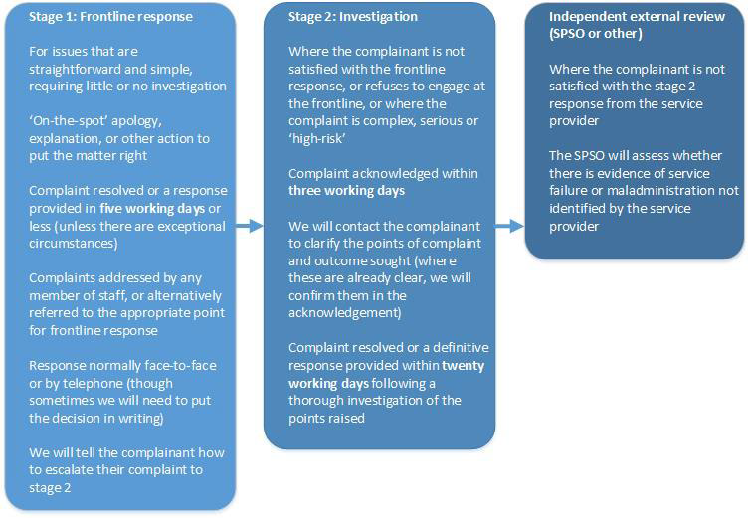
- Our complaints procedure has two stages. We expect the majority of complaints will be handled at stage 1. If the complainant remains dissatisfied after stage 1, they can request that we look at it again, at stage 2. If the complaint is complex enough to require an investigation, we will put the complaint into stage 2 straight away and skip stage 1.
- For detailed guidance on the process, see Part 3: The complaints handling process.
Stage 1: Frontline response
- For issues that are straightforward and simple, requiring little or no investigation
- 'On-the-spot' apology, explanation or other action to put the matter right
- Complaint resolved or a response provided in five working days or less (unless there are exceptional circumstances)
- Complaints addressed by any member of staff, or alternatively referred to the appropriate point for frontline response
- Response normally face-to-face or by phone (though sometimes we will need to put the decision in writing
- We will tell the complainant how to escalate their complaint to stage 2
Stage 2: Investigation
- Where the complainant is not satisfied with the frontline response, or refuses to engage at the frontline, or where the complaint is complex, serious or 'high-risk'
- Complaint acknowledged within three working days
- We will contact the complainant to clarify the points of complaint and outcome sought (where these are already clear, we will confirm them in the acknowledgement)
- Complaint resolved or a definitive response provided within twenty working days following a thorough investigation of the points raised
Independent external review (SPSO or other)
- Where the complainant is not satisfied with the stage 2 response from the service provider
- The SPSO will assess whether there is evidence of service failure or maladministration not identified by the service provider
Expected behaviours
- We expect all staff to behave in a professional manner and treat complainants with courtesy, respect and dignity. We also ask those bringing a complaint to treat our staff with respect. We ask complainants to engage actively with the complaint handling process by:
- telling us their key issues of concern and organising any supporting information they want to give us (we understand that some people will require support to do this)
- working with us to agree the key points of complaint when an investigation is required; and
- responding to reasonable requests for information.
- We have guidance in place for when these standards are not met which is our Unacceptable and Vexatious Behaviour Guidance.
- We recognise that people may act out of character in times of trouble or distress. Sometimes a health condition or a disability can affect how a person expresses themselves. The circumstances leading to a complaint may also result in the complainant acting in an unacceptable way.
- People who have a history of challenging or inappropriate actions, or have difficulty expressing themselves, may still have a legitimate grievance, and we will treat all complaints seriously. However, we also recognise that the actions of some complainants may result in unreasonable demands on time and resources or unacceptable behaviour towards our staff. We will, therefore, apply our policies and procedures to protect staff from unacceptable actions such as unreasonable persistence, threats or offensive behaviour from complainants. Where we decide to restrict access to a complainant under the terms of our guidance, we have a procedure in place to communicate that decision, notify the complainant of their right of appeal, and review any decision to restrict contact with us. Guidance on dealing with unacceptable or vexatious behaviour
- If we decide to restrict a complainant’s contact, we will be careful to follow the process set out in our guidance and to minimise any restrictions on the complainant’s access to the complaints process. We will normally continue investigating a complaint even where contact restrictions are in place (for example, limiting communication to letter or to a named staff member). In some cases, it may be possible to continue investigating the complaint without contact from the complainant. Our guidance allows us in limited circumstances to restrict access to the complaint process entirely. This would be as a last resort, should be as limited as possible (for a limited time, or about a limited set of subjects) and requires manager approval. Where access to the complaint process is restricted, we must signpost the complainant to the SPSO (see Part 3: Signposting to the SPSO).
- The SPSO has guidance on promoting positive behaviour and managing unacceptable actions.
Maintaining confidentiality and data protection
- Confidentiality is important in complaints handling. This includes maintaining the complainant's confidentiality and confidentiality in relation to information about staff members, contractors or any third parties involved in the complaint.
- This should not prevent us from being open and transparent, as far as possible, in how we handle complaints. This includes sharing as much information with the complainant (and, where appropriate, any affected staff members) as we can. When sharing information, we should be clear about why the information is being shared and our expectations on how the recipient will use the information.
- We must always bear in mind legal requirements, for example data protection legislation, as well as internal policies on confidentiality and the use of individuals’ information.
Further information can be found on our Data protection page - The University may find times where a response to a complaint may be limited by confidentiality, such as:
- where a complaint has been raised against a staff member and has been upheld – we will advise the complainant that their complaint is upheld, but would not share specific details affecting staff members, particularly where disciplinary action is taken.