News
Wellcome Career Development Awards awarded to Dr Wataru Kobayashi
Dr Wataru Kobayashi has been awarded £ 2.16M from the Wellcome Trust to study the earliest step of mammalian development
Published on 10 March 2026

The funding award will allow Dr Kobayashi and his team to research the mechanistic basis for trophectoderm lineage commitment during mammalian pre-implantation development.
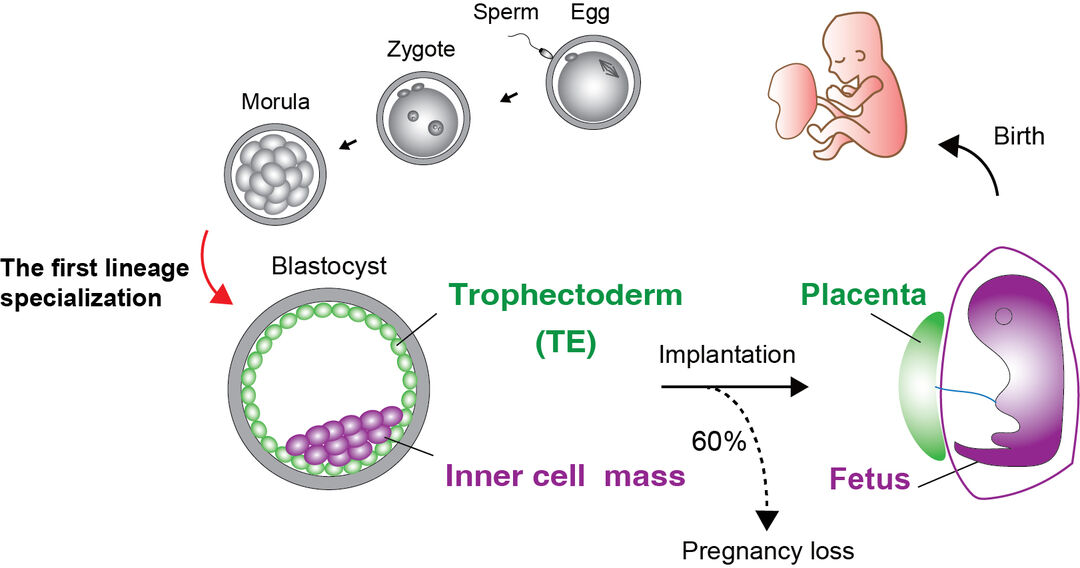
The life of mammals starts with fertilization of an egg, which subsequently undergoes multiple rounds of cell division and develops into a complete organism. During mammalian pre-implantation, cells undergo their first cell segregation into the inner cell mass and trophectoderm, which give rise to the embryo proper and extraembryonic tissue (e.g. placenta), respectively.
Dr Kobayashi’s award will support the research into how transcription factors regulate epigenetic reprogramming to drive trophectoderm lineage commitment, using mice as mammalian model. Studying the earliest developmental stages has long been challenging in large part due to the scarcity and limited number of cells in mammalian embryo. His team will use combined expertise in low-input genomics, biochemistry, and structural biology to investigate the fundamental mechanisms underpinning trophectoderm lineage commitment across scales, from atoms to embryos. The principles uncovered in this study will inform future studies of human development and further understanding of why inefficiency in the early stages of development is often a cause of infertility.
He said, “I’m grateful to Wellcome Trust for supporting this project for six years and enabling us to pursue this research vision. The trophectoderm differentiation represents the first cell lineage segregation in life, but we do not yet understand exactly its molecular mechanisms at the chromatin level. In the long-term, I hope to translate our findings by expanding our work to human systems.”