
News
New research shows how cells organise the forces that drive tissue formation
A cross-institutional collaboration between the University of Dundee and the University of St Andrews has uncovered new insights into how cells organise the forces that drive tissue formation during development
Published on 22 January 2026

Dundee authors Professor Rastko Sknepnek, PhD student Euan D. Mackay and Professor Jens Januschke
The study carried out by PhD students, Euan D. Mackay (Dundee) and Aimee Bebbington (St Andrews) and co-supervised by Professors Rastko Sknepnek and Jens Januschke (Dundee), and Drs Jochen Kursawe and Marcus Bischoff (St Andrews), combines advanced live imaging with physics-based computational modelling. The work has been published in the latest issue of Proceedings of the National Academy of Sciences (PNAS).
Professor Rastko Sknepnek, Chair of Biological Physics, explained, “Cells constantly generate forces that help shape tissues during development. These forces are produced by a network of proteins inside cells called actin and myosin, which can contract in a rhythmic, pulsing manner. Such pulsed contractions are commonly seen during important developmental events, but it has been unclear why they arise and how they are organised within cells.
“In this study, we focused on pulsed contractions that occur in epithelial cells of the fruit fly during the formation of the adult abdomen. Using advanced live imaging, we tracked how actin and myosin move and concentrate over time inside individual cells. We then developed a physics-based computer model that mimics the behaviour of this contractile network within realistic cell shapes.
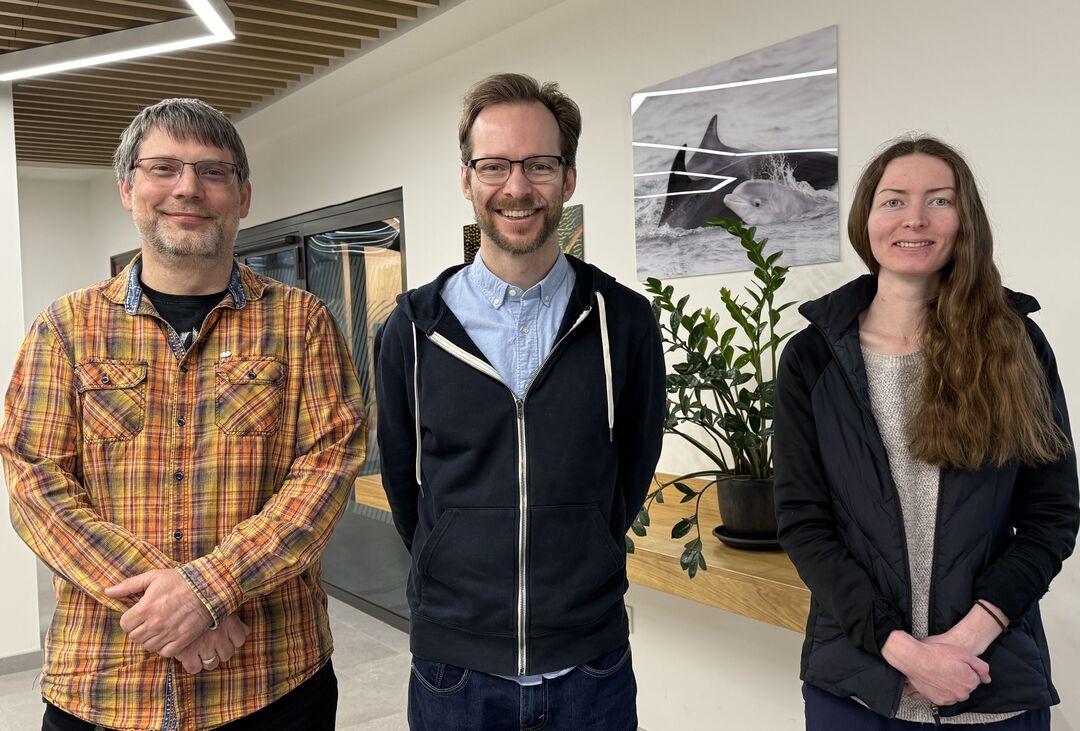
St. Andrews authors Dr Marcus Bischoff, Dr Jochen Kursawe and PhD student Aimee Bebbington.
“Our results show that pulsed contractions do not require an external timing signal. Instead, they naturally emerge from the physical properties of the actin–myosin network itself. Importantly, the shape of the cell, the cell’s internal polarity, and how the contractile network is organised together determine where pulses occur, how many form, and how they move. Models that used realistic cell geometries matched experimental observations much better than simplified shapes. The model also successfully predicted how contractions change when the contractile machinery is genetically altered.
“Overall, this work demonstrates that the geometry and internal organisation of cells play a key role in shaping rhythmic force generation during development. These findings help explain how complex patterns of cellular behaviour can arise from simple physical principles and may apply broadly to similar processes in other organisms.”
The work was supported by funding from the endowed E.N. & M.N. Lindsay PhD studentship (Euan Mackay in Dundee), St Leonard's College World Leading Scholarship (Aimee Bebbington, St Andrews), and UK Engineering and Physical Sciences Research Council (Rastko Sknepnek).
Read the research publication: https://www.pnas.org/doi/10.1073/pnas.2503955123
The full citation:
E.D. Mackay, A. Bebbington, J. Januschke, J. Kursawe, M. Bischoff, & R. Sknepnek, An active matter model captures spatial dynamics of actomyosin oscillations in larval epithelial cells during Drosophila morphogenesis, Proc. Natl. Acad. Sci. U.S.A. 123 (3) e2503955123, https://doi.org/10.1073/pnas.2503955123 (2026).