
News
10th Anniversary of the SLS Discovery Centre
It has been ten years since the Discovery Centre opened. Professor Sir Mike Ferguson looks back at how the Centre came to fruition and what has taken place since then.
Published on 24 October 2024
The Discovery Centre (for Translational and Interdisciplinary Research) was opened on October 1st 2014 by Sir Paul Nurse, then Director of the Francis Crick Institute and President of the Royal Society, with Brian Cox (aka Logan Roy of Succession), then Rector of the University of Dundee presiding as master of ceremonies.
The opening included a celebratory balloon-drop, tours of the building and a seminar by Sir Paul about the Crick Institute that was about to open in London.
Planning for the Discovery Centre started in 2009 when outgoing Principal Sir Alan Langlands encouraged Mike Ferguson, then Dean of Research for Life Sciences, to consider the next phase of Life Sciences growth - despite the bleak outlook following the 2008 financial crash.
To fuel this growth, Mike and colleagues obtained a £5 million capital grant from the Wellcome Trust in 2010, which was matched by the University of Dundee capital programme.
Morag Martin, then Life Sciences Research Strategy and Development Officer, and Mike raised a further £3 million from charitable foundations, individuals and agencies – in total £13 million, enough to build the Discovery Centre and to furbish two of its four floors.
Two floors were to be left as shell, awaiting future funding……that opportunity arose sooner than expected in the form of a £12 million UK Research Partnership Investment Fund (UKRPIF) grant, assembled by Mike and Morag and awarded in 2012.
In the end, the entire £25 million (equivalent to £37 million in today’s money), 5,000 m2, Discovery Centre was built and equipped by October 2014, with 80% of the costs raised from external sources.
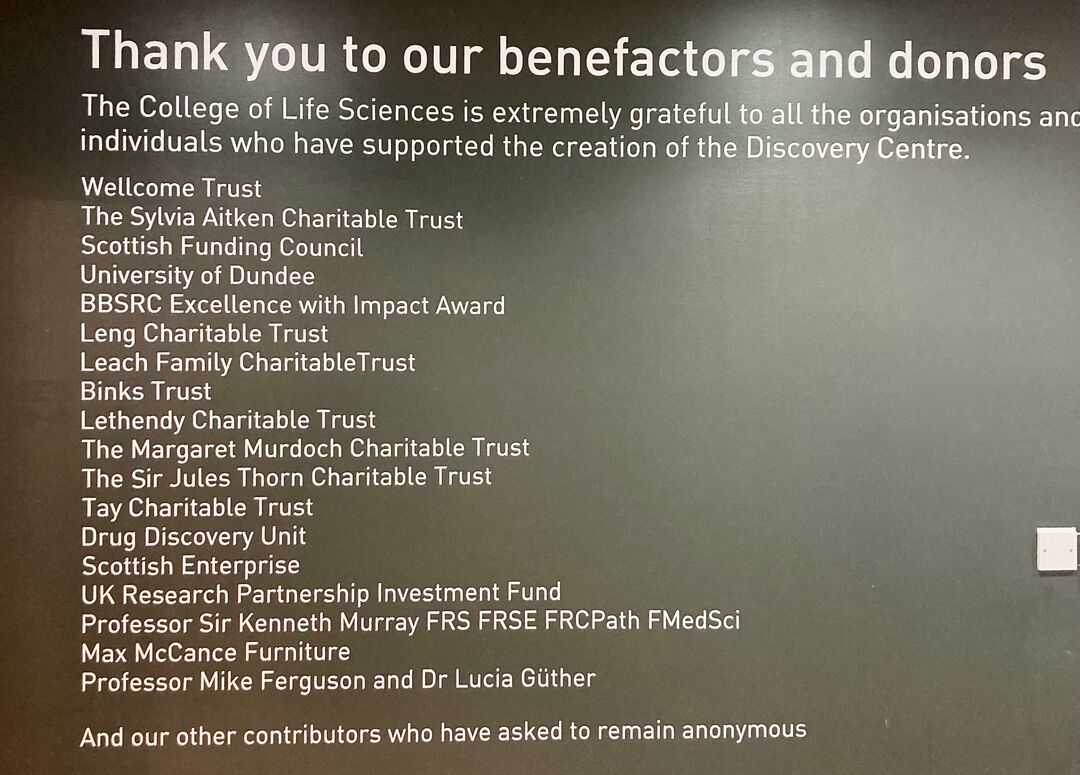
List of the benefactors and donors for the Discovery Centre, on the wall of the Street by the main entrance to SLS
Mike Ferguson said “Although I had the privilege of leading fund raising, and helping design the Discovery Centre with outstanding architect Jo White of BMJ Architects, the project involved a cast of thousands. I am not going to be able to thank all of them here, but special mention must go to Morag Martin for fund raising, grant writing support and project management, Ian Leith for business case support, Letty Gibson, Mark Austin, Brian Thomson and David Gray for input into lab design, and to academic colleagues who contributed to the scientific cases for the Wellcome and UKRPIF grants. The latter includes Angus Lamond, Geoff Barton, Paul Wyatt, Ian Gilbert, Jason Swedlow, Alan Fairlamb, Andrew Hopkins and Mark Chaplain. Also huge thanks to Doreen Cantrell for moral support when she was Head of the College of Life Sciences and Vice Principal, and to Lucia Guther who looked after my lab, and me, from start to finish.”
The Discovery Centre project also involved some refurbishment of JBC1, which allowed the recruitment of Alessio Ciulli from Cambridge, who now Directs the Centre for Targeted Protein Degradation (CeTPD).
The purpose of the Discovery Centre was to enable:
- Expansion of the Drug Discovery Unit (DDU), from about 60 to 135 scientists.
- Establishment of the Division of Computational Biology.
- Development of one of the world’s largest Quantitative Proteomics facilities.
- Commercialisation of life sciences and formation of spinout companies.
The overarching vision was to support translational and interdisciplinary research to meet global challenges and unmet medical needs.
A recent official audit, up to July 2023, attributes a cumulative increase of 231 jobs and £87 million of research funding to the existence of the Discovery Centre, with a third of that funding coming from outside the UK, in particular from the Bill & Melinda Gates Foundation.
Notable achievements associated with the Discovery Centre to date include:
- For the expanded DDU: Delivery of new drug candidate cabamiquine for malaria, in phase 2 clinical trials in Africa, two new clinical drug candidates for leishmaniasis, two advanced lead drug candidates for tuberculosis, clinical drug candidate zelenirstat for leukaemia, in phase 2 trials in the US, and a strong pipeline of advanced drug leads for infectious and neurodegenerative diseases, non-hormonal contraception and for cancer. In addition, the Discovery Centre has facilitated innovation in Drug Discovery including new computational methods, the application of Roland Wolf’s (School of Medicine) humanised model for drug metabolism, automated chemistry, and new biophysical methods and cellular assays.
- For the Division of Computational Biology (CB): CB now spans the molecular, intracellular and cellular scales for physics-based simulations as well as cutting edge technology development in machine learning, image and biological sequence analysis. It houses two major international resources: The Open Microscopy Environment, a research tool with thousands of installations worldwide in academia and industry for image sharing and analysis; and Jalview and related resources which provide state of the art visualisation and analysis tools for DNA, RNA and Protein sequences with over 100,000 users worldwide. One of Jalview's key papers recently became the most highly cited publication of all time for the University of Dundee! Work by CB scientists on the molecular dynamics of ion channels, soft-matter physics related to developmental biology, machine learning and AI applied to epigenetics, very large scale sequence analyses and microtubule dynamics illustrate the breadth and depth of CB research.
- For the Proteomics Facility: Attracting flagship national projects involving large-scale proteome analyses, including the Human Induced Pluripotent Stem Cell Initiative. Supporting quantitative proteomics to generate novel insights about immune cells and drug mode-of-action studies. Underpinning a huge range of publications and grant funded projects by researchers, across the campus and beyond, that benefit from access to state-of-the-art proteomics instrumentation and expertise. Supporting commercial proteomics projects, including those delivered by the UoD spin-out company Platinum Discovery.
- For commercialisation and spinout: The Discovery Centre has provided scientific founders and/or scientific infrastructure support for several Dundee spinout and startup companies. These include: Amphista Therapeutics, Outrun Therapeutics, PhaSER Bio, Platinum Discovery, Tartan Cell Technologies and Tay Therapeutics. The Fingerprints proteomics facility and the DDU have also helped numerous companies to access key technologies on a contractual basis.
The current occupants of the Discovery Centre include the following and their teams:
- For the DDU & BCDD: David Gray, Kevin Read, Beatriz Baragana, Laura Cleghorn, Manu de Rycker, Mike Bodkin, Mike Ferguson and Uli Zachariae
- For CB: Geoff Barton, Jason Swedlow, Rastko Sknepnek, Andrei Pisliakov, Gabriele Schweikert, Hajk Drost, Maxim Igaev.
- For Quantitative Proteomics: Angus Lamond, members of the Tony Ly, Nicola Ternette, Glenn Mason, Doreen Cantrell and Susan Wyllie groups, and of course the excellent Fingerprints Proteomics team.
Added bonuses from the Discovery Centre project include the provision of offices on the bridges between the Discovery Centre and the JBC buildings, more bookable meeting rooms, the Murray Seminar Room, networking and breakout spaces on the Mezzanine and 4th floors, the creation of the LifeSpace Art/Science gallery and the formation of the Street for networking, events and coffee.
The Murray Seminar room was made possible by a generous donation by Sir Ken and Lady Noreen Murray, and the Mezzanine floor networking space was made possible by a £150,000 BBSRC Excellence with Impact Award to SLS in 2011, coordinated by Kate Storey. Above the Mezzanine networking space hangs a bespoke CELL lighting feature by Kevan Shaw.
Last, but not least, the Discovery Centre project provided some outside seating and information boards and public art. The public art is in the form of the perforated aluminium panels that adorn the Discovery Centre exterior. This artwork, designed in collaboration with professor of fine-art and printmaking Elaine Shemilt and architect Jo White, is called The Scales of Life and is intended to be aesthetically pleasing to the general public while representing the range of research at different length-scales that occurs within SLS.
The Discovery Centre was the fourth building of the School of Life Sciences, after the Medical Sciences Institute (1970), the Wellcome Trust Building (1998) – which celebrated its 25th Anniversary last year and highlights how Sir Philip Cohen initiated the growth of SLS - and the Sir James Black Centre (2006).
The SLS Plant Sciences Division also occupies parts of the James Hutton Institute, and the Centre for Targeted Protein Degradation (CeTPD) which opened in January 2023 occupies the former Cyclacel building, just across the Hawkhill on the Technopole site.
A £40 million, 5,000 m2, Life Sciences Innovation Hub for spinout and startup companies, located just behind CeTPD, will complement this estate when it opens in 2025.
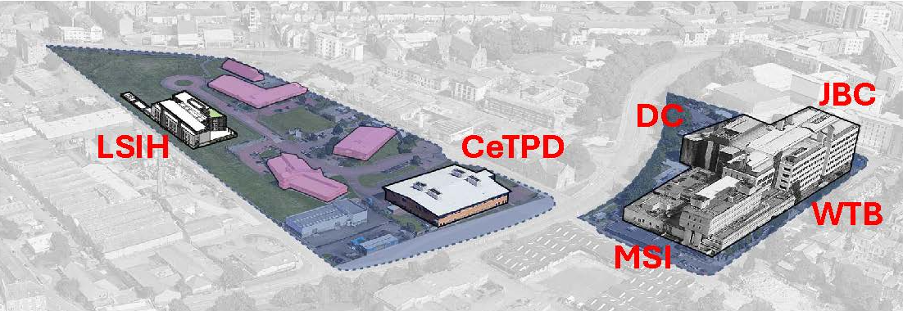
The SLS complex (right) consisting of the Medical Sciences Institute (MSI), Wellcome Trust Building (WTB), Sir James Black Centre (JBC), the Discovery Centre (DC) and the Centre for Targeted Protein Degradation (CeTPD) and Life Sciences Innovation Hub (LSIH) on the Technopole site (left). The SLS Division of Plant Sciences also occupies space at the James Hutton Institute in Invergowrie.