
Feature
The future of medicine
Three pioneering treatments for patients with brain disorders are being developed right here in Dundee...
Published on 21 November 2025


The brain is an incredible organ. From controlling the physical actions in our body to giving us the ability to have hopes, dreams, and feel a whole plethora of emotions, it’s part of our lives from start to finish.
But what happens when something goes wrong with such a complex and delicate part of us? From strokes to brain injuries to diseases like Parkinson’s, there are many ways in which the brain can be damaged. However – thanks to researchers at Dundee – ways in which we can treat brain disorders are developing, too.
The remote-control brain surgery specialist
Imagine you or someone you love suffers from a medical emergency – a blood clot in the brain that requires urgent medical attention. You’d want the best care available, right? But what if the medical expert is thousands of miles away in another country?
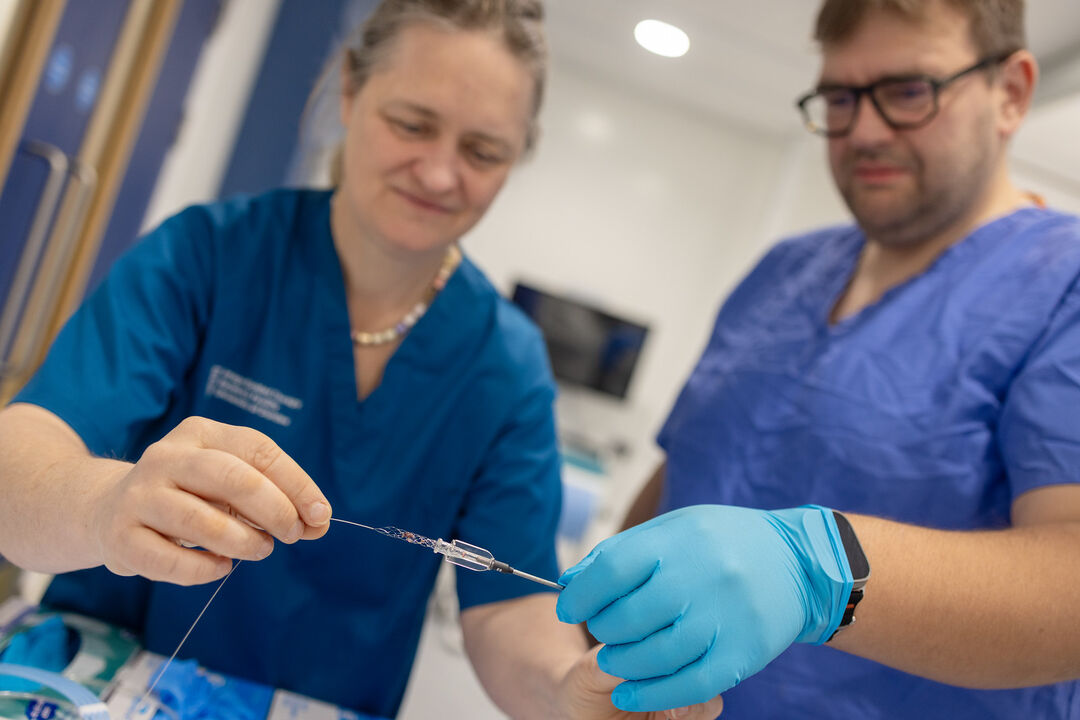
The work of Dundee researcher Professor Iris Grunwald is making that distance less of a barrier to high quality care. A Consultant Diagnostic and Interventional Neuroradiologist, Iris has recently completed the world’s first remote thrombectomy, performing the surgery on a human cadaver from another location within the University’s Ninewells campus.
That technology is a cutting-edge robot that uses guidewires and catheters that are connected to a device equipped with a high-resolution sensory system that captures the specialist's hand movements. These manipulations are replicated in real time by a robot at the patient's bedside.
Each year, around 15 million strokes occur worldwide. The estimated aggregate societal cost for this in the UK is £26 billion per year, £8.6 billion being attributed to NHS and social care.
With future-focused treatments like this being built in Dundee, we could soon see more thrombectomies – the treatment considered most effective for treating patients with strokes caused by large brain vessel blockages – being undertaken remotely, and saving lives and money in the process.
The life-changing procedure supporting essential tremor patients
Essential tremor is the most common movement disorder. It’s a medical condition that sees the patient experience involuntary muscle contractions and relaxations, usually affecting the hands and arms, but often affecting other parts of the body.
Understandably, it can be hugely debilitating for patients. As well as physical symptoms, it can also cause frustration, lack of confidence in performing daily tasks, and lead to patients withdrawing from everyday life.
One treatment for the disorder is thalamotomy – a surgical procedure used to treat tremor by creating a lesion in the thalamus, the part of the brain that controls a person’s movements.
This process comes with risks, and so researchers at Dundee have been developing non-invasive treatments using high-intensity focused ultrasound, allowing for incision-free treatment to be administered to the patient.
Ultrasound thalamotomies allow doctors to perform precision surgery without the need for incision, and results are usually seen almost immediately.
That was the case for Ian Keir, who was the first patient in Scotland to be treated with an ultrasound thalamotomy by the Dundee team. Ian, who suffered from tremors caused by Parkinson’s disease, found the symptoms began to interfere with his day-to-day life.
Following the surgery, Ian admitted that it felt “like a miracle” and that he was looking forward to “make[ing] the most of every day” with reduced symptoms.
Dr Tom Gilbertson, the Consultant Neurologist and Honorary Senior Lecturer who led the operation, said “This is a milestone moment for Scottish medicine.
“We are well versed in performing thalamotomy, having worked with Essential Tremor patients for several years now. However, we never fail to recognise the significance of what we are doing, and the life-changing impact it has on our patients.”
Solving the Parkinson’s puzzle

While treatments for the symptoms of Parkinson’s help address the issues that patients face, there’s still a long way to go to find a cure for the condition.
However, researchers at Dundee have made major strides in beginning to understand one of the key protein kinases that causes Parkinson’s disease when it malfunctions. That protein kinase, PTEN-induced kinase 1 (also known as PINK1) is a master regulator of a damage response pathway that exists in cells like neurons. In healthy conditions, PINK1 is inactive. However, when the cells undergo selective mitochondrial stress, PINK1 is activated and can lead to Parkinson’s disease in patients.
Now, researchers at Dundee have discovered a potential drug target to help treat Parkinson’s disease. By manipulating the switching on of PINK1 and another gene, Parkin, which also affects the development of Parkinson’s, we may now be able to create drugs that will do this in patients in the future.
Professor Miratul Muqit, Consultant Neurologist and Professor of Experimental Neurology, leads the team looking at this new advance, and is also the inaugural Director of the UK Dementia Research Institute (UK DRI) Parkinson’s Research Centre.
He says, “As a practising neurologist, I am acutely aware of the lack of disease-modifying therapies for people with Parkinson’s. My vision is to build a centre fully integrated with people with Parkinson’s and which will become one of the world’s leading centres for discovery science and translation that will deliver new ideas for better diagnosing and treating Parkinson’s in the future.”
With expertise across medicine and life sciences, and with scientists working alongside clinicians to take research from the laboratory bench to the patient’s bedside, Dundee is a place where research is becoming reality. And the future reality for patients living with brain disorders could be a treatment that was developed right here in Dundee.
You don't have to be a leading scientist or doctor to help advance the future of medicine - you can support our mission by sharing a gift to help us further our research.
Together we can transform lives.