
Feature
A bold woman and a big idea: Mary Ann Baxter and the foundation of the University
In 1881, Mary Ann Baxter and her cousin John Boyd Baxter gave a gift that would change Dundee forever. Their vision of a college open to everyone became the University of Dundee we know today.
Published on 12 November 2025


From University of Dundee Archives: CMS 1/1 (33) A c 1900 view of the original four houses on the Nethergate that were purchased with Mary Ann Baxter's money and were adapted to become the main building of University College, Dundee.
Back in 1881, long before V&A Dundee landed on our waterfront and when the streets of Dundee echoed with the clatter of jute mills, a remarkable local woman decided it was time for change.
This woman was Mary Ann Baxter. She came from a family of wealthy linen merchants, and was already a well-known philanthropist. You probably know her name from Baxter Park, which she and her siblings gifted to Dundee in 1863.
Learning for everyone
Together with her cousin, John Boyd Baxter, Mary Ann donated £140,000 (over £14 million in today’s money) to create a new college in the heart of Dundee.
Mary Ann was a progressive thinker and her dream was for a modern and forward-thinking place of learning. It wasn’t just to be for the elite but would open its doors to everyone - men and women alike.
As the founding deed stated, it would provide:
There was also one key condition: there was to be no religious instruction and no-one had to declare their faith. In 1881, that was revolutionary.
A new kind of university
The Baxters didn’t set out to create an old-fashioned institution full of distant professors tucked away in ivory towers. Instead, they brought in bright, young minds who knew the future lay in science, technology, and progress.
The first principal, Latin scholar William Peterson, was only 26 years old - barely older than many of our students today. Patrick Geddes, the first botany professor, didn’t even have a degree, but he was already a visionary thinker who would go on to reshape modern town planning.
Thanks to generous funding from the Baxters, the new University College quickly expanded. A Mechanics’ Institution was built next door, a Chemistry lab went up, and leading minds were recruited to shape the future.
The earliest lecturers included:
-
D’Arcy Wentworth Thompson, Biology (later Natural History)
D'Arcy Thompson became one of the greatest zoologists of the 20th century. You can still see some of his collections in the D'Arcy Thompson Zoology Museum on campus today.
- James Alfred Ewing, Engineering
Ewing was a Scottish physicist and engineer who became famous for his work on the magnetic properties of metals. During the First World War, Ewing headed Room 40, the Admiralty intelligence department which decrypted German naval messages, including the famous Zimmerman telegram in 1917 that helped bring America into the war. On campus today, the Ewing building forms part of the School of Science and Engineering.
- Thomas Carnelley, Chemistry
Carnelley was one of the most brilliant chemists of his time. He worked to improve the air quality within buildings, even examining the air and smells in the House of Commons in 1886. The Carnelley Building on campus, which bears his name, had one of the first air-conditioned chemical labs in the world.
Clearly, these weren’t your typical Victorian academics. These men were innovators.
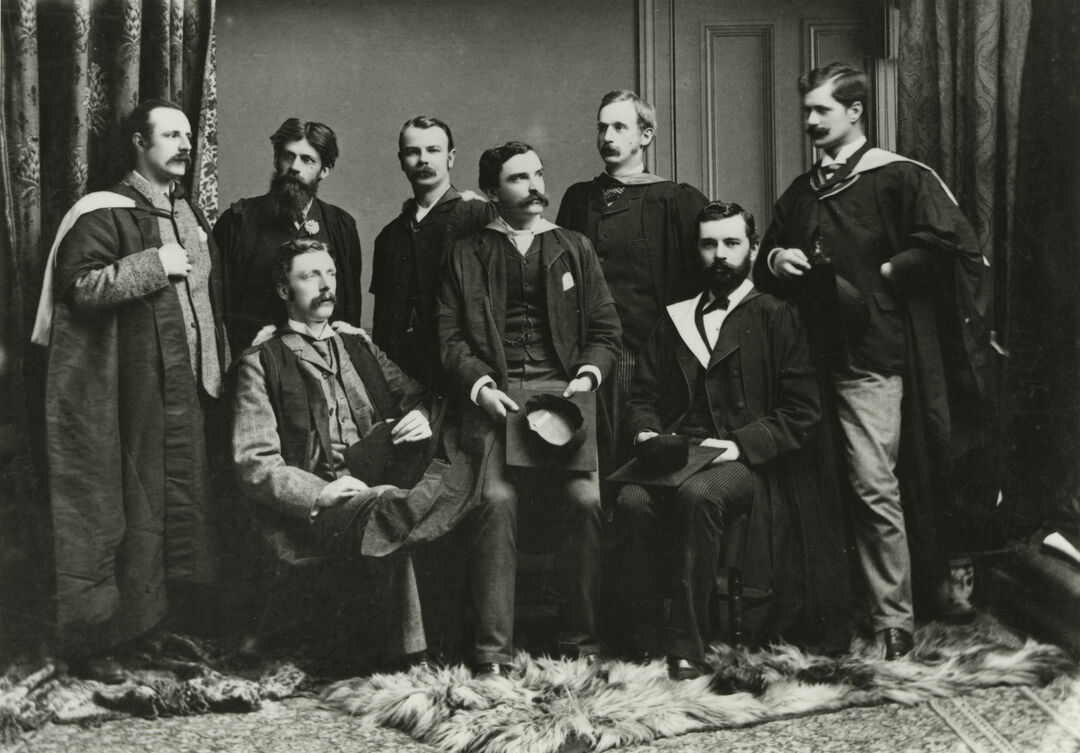
The Professors of University College in 1889. They are (standing L-R) Professor JEA Steggall, Professor Patrick Geddes, Professor James Alfred Ewing, Professor A. M. Paterson, Professor Percy F. Frankland. (Sitting L-R) Professor D'Arcy Wentworth Thompson, Principal William Peterson, Professor Thomas Gilray. Image from University of Dundee Archives CMS 2/1 (25)
A legacy that lives on
The college found its home on the Nethergate, between Park Place and Small’s Wynd - right where our University still stands.
To house the 373 students who signed up in year one, Mary Ann Baxter bought four detached houses for £35,000 and had them connected by a corridor at the back. They would stand until the late 1950s when the eastern two houses were cleared to make way for the Tower Building. The remaining two were demolished a few years later for the Tower Extension.
More than 140 years later, we're still shaped by Mary Ann Baxter’s vision: a university built on innovation, inclusion, and inspiration.
William McGonagall, "The Inauguration of University College Dundee"
So next time you walk past the University buildings on the Nethergate, spare a thought for Mary Ann - one of Dundee’s greatest unsung heroes - who believed Dundee could be a centre of knowledge, creativity, and progress.
And she was right.