

Karen Westland

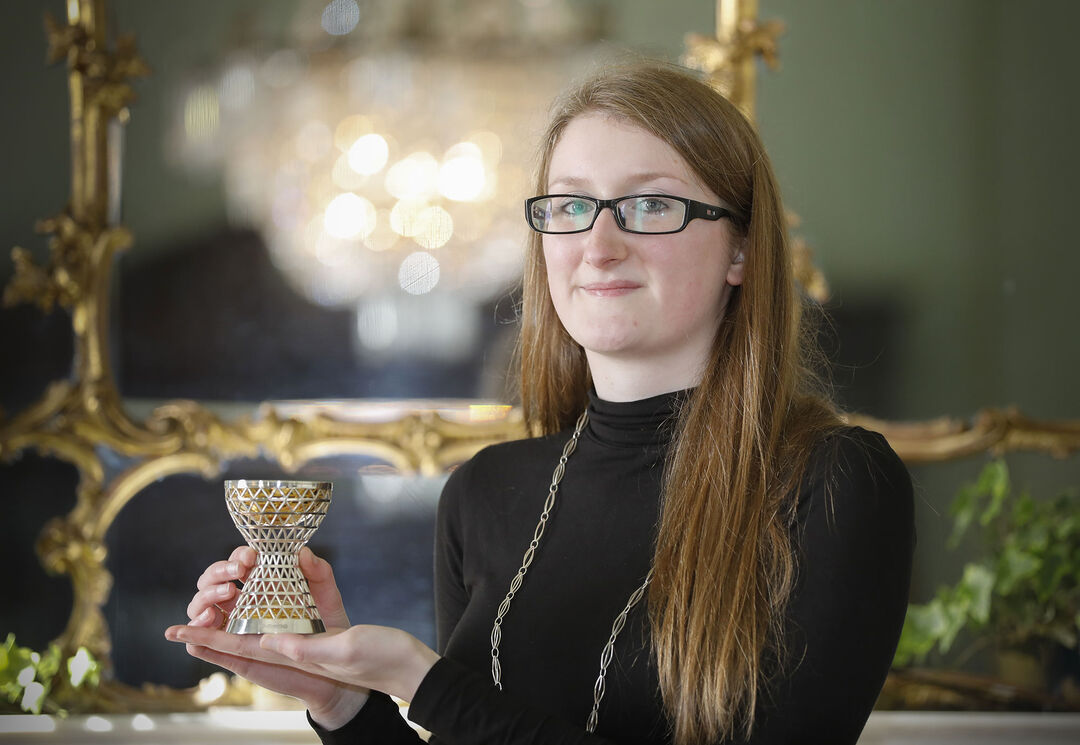
Karen is working at the intersection of science and art, having joined the Physics group from a background of silversmithing in order to research solar lasers. She was the runner up in the 2019-20 Semester 1 Enterprise Challenge with her project Science Unboxed, a brokerage service connecting scientists to artists and designers, and she also won an award in the Scientistt physics poster competition.
What did you do before starting your research degree at Dundee?
I graduated from The Glasgow School of Art in 2015 with a BA(Hons) in Jewellery and Silversmithing Design and established as a self-employed silversmith, before venturing down to Oxfordshire for an 11-month residential course in traditional silversmithing. From mid 2016 I set up my silversmithing workshop and have learnt from master craftsmen while honing my own skills through commissions and developing new work ever since. I have had brilliant opportunities including shaking hands with Scotland’s First Minister when I displayed my carafe, beakers and a goblet in Bute House and an incredibly exciting commission I completed last year that I can’t yet reveal!
What is the focus of your current research?
My research project investigates solar concentration in physics and craft. On the physics side: we aim to improve the efficiency of a solar laser - a type of renewable energy – through fabricating custom optics and on the craft side we are exploring solar concentration to heat and melt materials for sustainable craft purposes. The third chapter to the research explores collaboration between the scientific and creative fields, using this project as a case study to inform future practice.
What first got you interested in your research topic?
In 2013 I was on exchange in Japan where I found myself curious about why the Moon featured in the Ukiyo-e (traditional Japanese woodblock prints) while the Sun was rarely depicted. This led to my degree show collection exploring the social and environmental impact of space exploration, where I was fortunate to be awarded the GSA Sustainability prize as I had used 100% recycled materials, which was significant for its time. These themes continued in my work till the PhD opportunity arose to utilize my silver fabrication skills to make optical components to aid the development of renewable energy, combining all my interests!
What has been the most positive aspect of your research degree so far?
After over a year and a half of solitary working day-in day-out in my workshop as a silversmith, being connected to an incredible network of technicians and lecturers between the School of Science and Engineering and DJCAD, not to mention all my fellow students, has been an absolute pleasure. I enjoy working independently but having access to highly skilled and knowledgeable individuals is an incredibly powerful resource to bolster the remarkable work we all do at Dundee.
What has been the most challenging aspect so far?
As someone who finds verbally communicating my greatest challenge, I find myself continually moving between pushing myself to expand my ability but also giving myself space to be in my comfort zone to be comfortable with this aspect of my personality. I have found taking part in the programs the Centre for Entrepreneurship host have really helped me have more opportunities to practice speaking in a safe environment, making networking events and conferences that much easier.
How are you hoping your research will benefit others?
First and foremost, I hope this research will encourage others to pursue interests out with their own field to open the possibility to discover. Did I imagine I’d be conducting research within the School of Physics- absolutely not: but my curiosity led me from the Japanese prints to here. On a practical level, my optical components play a small role in the overall development of solar lasers, and the sustainable craft processing is of relevance for material processing in sunny developing countries. Lastly my findings for interdisciplinary collaboration can be applied to similar projects to improve the overall experience.
What advice would you give to postgraduate research students?
When you start to feel yourself approaching the points where you need to make a decision about your research direction or which methods to employ etc.: remember, this research is yours! Therefore, make sure you are forming it in a direction that interests you and you can proudly own and justify at the end of all your hard work. Seek advice and learn from others, then make the executive decisions for where you take your project, ensuring you are fulfilling your project parameters whilst taking initiative.